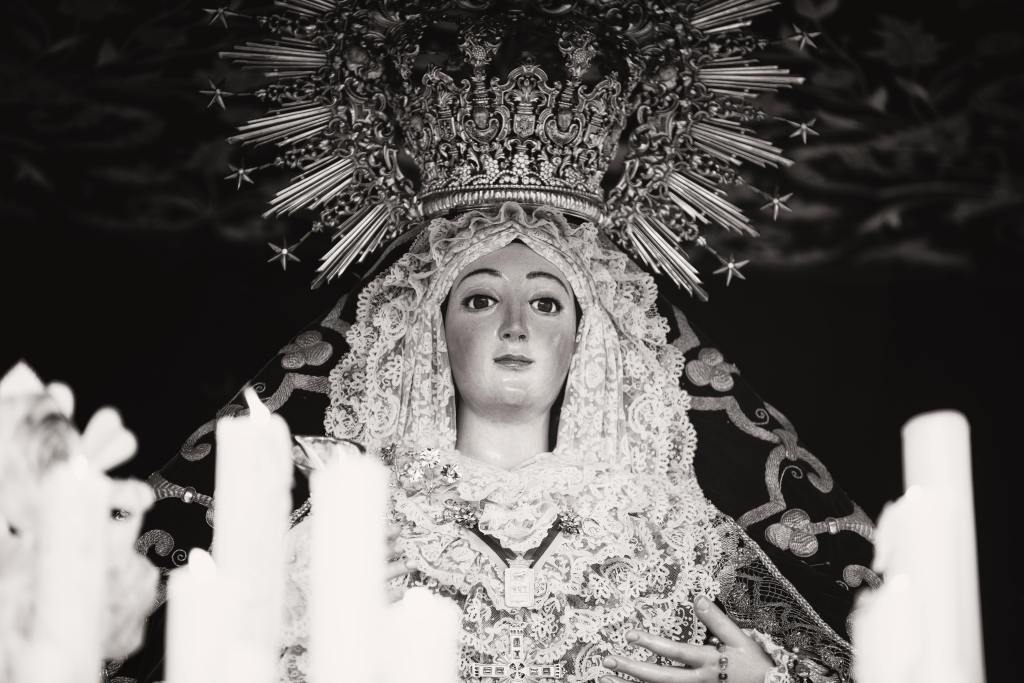
There’s a quiet but crucial distinction between honor and exaltation — one that Scripture maintains carefully, yet tradition has often blurred. Mary, the mother of Yeshua (Jesus Christ), is one of the most beautiful examples of surrender and faith in all of Scripture. Her “yes” to God changed history, and helped shape not only our earthly futures, but the eternal futures of all mankind as well.
However, over time, that rightful honor has, in many circles, transformed into something Jesus Himself never endorsed.
As Jesus was teaching, “a woman in the crowd raised her voice and said to Him, ‘Blessed is the womb that bore You, and the breasts at which You nursed!’ But He said, ‘Blessed rather are those who hear the Word of God and keep it.’” ~ Luke 11:27–28
At first glance, this woman was simply honoring Mary — as any Jewish woman might, seeing the greatness of the Son and attributing honor to His mother. But Jesus’s answer gently redirected the praise. He shifted the focus from human relationship to spiritual obedience.
“Blessed rather are those who hear the Word of God and keep it.”
With one sentence, He corrected the human tendency to elevate the earthly above the eternal.
Mary was indeed blessed — but not because she bore Christ. She was blessed because she believed Christ. (Luke 1:45)
When Honor Becomes Exaltation
The Catholic Church teaches three levels of “honor”:
Latria – worship, due to God alone.
Dulia – veneration, given to saints.
Hyperdulia – a “special” veneration, reserved for only Mary, the mother of Christ.
Catholics claim they do not worship Mary, but rather “venerate” her as the most exalted of all created beings. Yet, this “special veneration” steps beyond Scripture’s boundaries. Jesus Himself never instructed His followers to pray to, through, or in honor of His mother. Instead, He repeatedly pointed all attention to the Father.
“My mother and My brothers are those who hear the Word of God and do it.” ~ Luke 8:21
“Whoever does the will of My Father in heaven is My brother and sister and mother.” ~ Matthew 12:50
In both statements, Jesus dissolves the idea of elevated family privilege. His true family are those who obey God — not those connected to Him by flesh or birth.
Being adopted into the family of Christ by Spiritual obedience is far greater and more important than whose earthly lineage we share.
The “Perfect Womb” Argument
Many Catholics claim that Mary had to be sinless because “God could not have allowed His Son to be born of an imperfect womb.” But that idea, however poetic it might sound, not only has no biblical basis, it also goes against Biblical truth.
Now, before going any further, let me be very clear:
this is not written out of hostility toward Catholics, but out of love and concern for truth — and for the salvation of my Catholic brethren, created and cherished by God just as we all are.
Love compels me to speak plainly when Scripture is twisted to uphold man-made traditions. My heart is not to tear down, but to shine light — because anything that adds to or alters the Word of God not only endangers the purity of the gospel itself, but also endangers the souls being led astray by those additions and alterations.
I truly fear for those who have been taught to elevate human authority above divine revelation — something God does not look kindly upon.
One of the most sobering realities in this world is that there are many who believe they are walking in truth and salvation, yet are unknowingly following a path built on deception. And ignorance will not be an excuse before God. His Word calls each of us to test what we are taught — to measure every doctrine, every tradition, and every word against the Scriptures He has graciously placed within our reach.
It is our own responsibility to ensure that we do not follow flawed or false teachings, no matter how long they have been accepted or how beautiful they may appear. True beauty is not found in ritual or tradition, nor in the mother of Christ or exalting her — but instead in Christ Himself, and in what He has done for us.
Are you still willing to follow God if obedience means letting go of your most sacred routines? If following Christ means stepping away from long-held traditions — even the ones that feel holy, the ones you were taught were ‘good’ — would you still follow Him then?
Would you still trust Him if He asked you to stop praying to saints – all saints?
Would you still trust Him if He asked you to stop relying on priests to forgive your sins through rituals like repeated prayers or penances — which Scripture never commands — and instead come directly to Him, confessing to God in true repentance, and confessing to your brethren only for accountability, not for forgiveness, which no human — not even men of God — can give?
Could you bear to lose religion in order to gain relationship?
Would you still kneel before the cross if it meant walking away from the rituals that comfort you, but contradict His truth?
With that all being said, now let’s first consider the fact that if God could cause His Spirit to overshadow a virgin — bringing forth a perfect, sinless Savior — then surely that same Spirit could do so without requiring a sinless vessel.
Perfection was never found in Mary’s flesh; it was found in the One whom she carried.
Romans 3:23 makes it plain: “For all have sinned and fallen short of the glory of God.”
Jesus did not say, “For all have sinned and all have fallen short of the glory of God, except My blessed mother Mary, holy be her name, praise and veneration be to her and her righteous womb.”
“All” includes Mary. Her own song of praise — her Magnificat — reveals her awareness of that truth. In Luke 1:46–47, she says: “My soul magnifies the Lord, and my spirit rejoices in God my Savior.”
She called God her Savior, and therefore understood her own need for salvation. A sinless being would need no Savior.
And following that logic, if Mary had been perfect, not only would she have no need of redemption, but neither would anyone else, because her perfection would have destroyed the very foundation of salvation itself.
If even one human being — no matter how humble or holy — could achieve perfection apart from Christ, then none of us would have needed a Savior at all, because that would mean that humanity was capable of saving itself.
And therefore the cross would have been utterly unnecessary. Christ Himself would have been utterly unnecessary.
And if we were to follow the “sinless womb” argument to its logical end, it would unravel entirely.
If Jesus could only be born of a sinless mother, then so would Mary herself have needed to be born of a sinless mother — and that mother of another sinless mother — and so on and so on without end.
But Scripture and history tell a different story: the genealogy of Jesus includes imperfect, even scandalous, individuals — among them Rahab the prostitute and Bathsheba, the wife of Uriah, an adulteress.
Yet through that very lineage, through the prostitute Rahab and the adulteress Bathsheba, as well as many other flawed and broken men and women, the holiness of God broke through human imperfection.
And is that not one of the most wondrous aspects of His divine beauty?
The miracle of the incarnation isn’t that the vessel was pure, but instead that God’s power is perfect even through impurity and imperfection itself.
Through brokenness, He created not only the whole, but the Holy. He redeems the line, the vessel, and the whole world through His holiness — not ours. And certainly not hers. It is through the holiness of Christ, and Christ alone.
Praying to the Dead — and the Claim that she ‘Isn’t Dead’
Another common justification is: “We don’t worship Mary. We just ask her to pray for us, since she’s alive in heaven.”
But Scripture draws a firm line against any attempt to communicate with the dead — even the righteous dead.
“There shall be found among you not one who… calls upon the dead.” ~Deuteronomy 18:10–12
While believers who have gone to heaven are spiritually alive in Christ, yes — their souls continuing on with the Lord — their earthly bodies have died. They therefore have no power to act or intercede on behalf of those still on earth. God alone has the authority to hear and answer prayer.
There is but one Mediator — not two. The dead do not hear our prayers, no matter who that dead may be. Or who that dead gave birth to.
Scripture makes it clear that we can pray to God the Father, and to God the Son as our Mediator — and that is all. That is it. No other, no more.
“For there is one God, and one Mediator between God and men, the man Christ Jesus.” ~ 1 Timothy 2:5
Nowhere does Scripture invite us to pray to departed saints, angels, or even Mary. Our access to God is not through a heavenly chain of intercessors. It is through Christ, and Christ alone.
Twisting Truth Into Tradition
Catholicism often cloaks these doctrines in beautiful language — “Mother of Mercy,” “Queen of Heaven,” “Our Life, Our Sweetness, Our Hope.” But those titles belong only to God. God is “the Father of mercies.” (2 Cor. 1:3) Jesus is “our hope” (1 Tim. 1:1). The Holy Spirit is “the Advocate” (John 14:16).
When devotion begins to assign divine roles or attributes to a created being — even one as faithful as Mary — it crosses into dangerous territory. What begins as honor quickly becomes idolatry. If Jesus Himself did not exalt or venerate His earthly mother, then why should we, as His followers, believe that we ought to do so?
The True Blessedness
Mary’s blessedness came not from being sinless, but from being surrendered.
Not from being worshiped, but from being willing.
“Behold, I am the handmaid of the Lord; let it be to me according to your word.” ~ Luke 1:38
That’s the kind of faith Christ called blessed. Not the womb, not the title, not the veneration, definitely not the person herself— but the obedience.
When the woman in the crowd shouted her praise, Jesus gently turned her eyes from His mother to His mission: to draw hearts to obedience, not admiration.
In the End
Mary’s story is not one of hierarchy, but of humility. She is not a bridge to God — she was simply a vessel chosen by Him. And even she would tell us, still, today: “Do whatever He tells you” (John 2:5).
And what He tells us is that no human — not even the most faithful — is or ever was sinless or perfect. No human should be prayed to or through. And no human should be idolized, nor should images be made of them for people to kiss, bow to, or pray before in worship.
True honor to Mary is found not in exaltation, but in imitation — in hearing the Word of God and keeping it.
So please, always test your teachings against the Word itself.Trust only God the Father — not the “father” at mass — and follow the voice of the true Shepherd, Jesus Christ. He alone is worthy of our prayers, our faith, and our worship.
Amen and Amen!
☩ One cup. One Christ. One calling. ☩
Sunday Morning Coffee & Christ


Leave a comment