As the last of the frogs lay dying in heaps across Egypt, their stench rising like a warning unheeded, the land barely had time to breathe before judgment came crashing down once again.
The sun baked Egypt’s sand into a blinding glare, a desert of glittering grains stretched endlessly. But then the ordinary shifted. Aaron’s staff struck the ground, and before their very eyes the dust stirred to life.
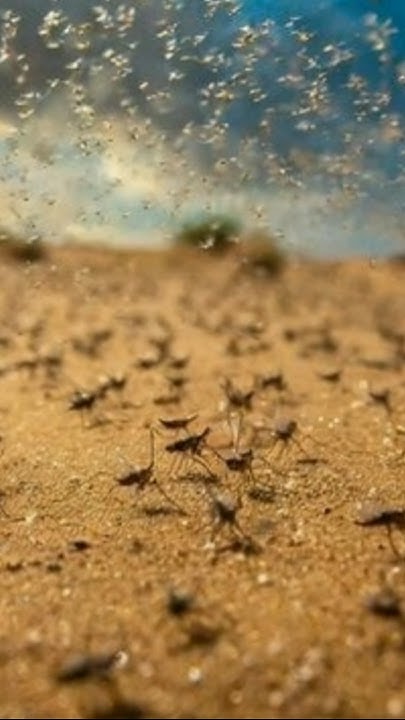
From the dust they came — millions of them. Tiny, relentless, and fierce. A crawling storm rose from the earth, insects so small they were almost invisible, erupting into a living cloud; coating flesh, creeping up noses, into eyes, ears, hair, and beards… no one could escape the bite of judgment.
What was once harmless dirt became a swarm of holy disruption — proof that God doesn’t need thunder or fire to shake a kingdom. Sometimes He uses the most minuscule of things.
If this happened today, it would be just as physically horrific, yes—but it wouldn’t hold the same spiritual weight. To us, dust is merely dirt: unpleasant, messy, and otherwise ignored, if we’re not vacuuming it away. But to the Egyptians, this was yet another attack on a much-revered and supposedly “mighty” god.
To the Egyptians, dust wasn’t just dirt. No — Dust belonged to Geb (pronounced G-ebb, with a hard ‘g’), the god of the earth. He was believed to steady the land, guard the soil, and keep the very ground beneath their feet secure. The dust of Egypt was Geb’s domain, his strength, his sacred territory.
But Egypt didn’t look to Geb alone. Khepri (“KEP-ree”) —the scarab-headed god of creation and rebirth— was believed to bring life out of the earth itself. Each morning, as the scarab “pushed” the sun into the sky, Egyptians saw it as Khepri shaping life from the dust, animating the world with unseen power. If ever there were gods who should have controlled the dust… it should have been these two.
But in a single divine command, what should have been stable became swarming; and what should have been sacred became judgment.
Yahweh had already shown them that even their frog-headed goddess couldn’t stop actual frogs sent by the true God Himself… but surely their god of the earth —the god of the very ground they walked upon— could stop dust… right?
And surely Khepri, the one who supposedly breathed life from the soil, could prevent that life from turning against his own people… right?
But no matter how much they prayed to Geb, no matter how many idols they carved in his image or how much they sacrificed in his name, he had always been —and would always remain— utterly impotent. Powerless. False.
And Khepri, for all his symbols of rebirth and creation, stood just as silent. Just as lame. Just as false. And a false god will always shatter, crumble, and disappear in the face of the One true God — crumble and disappear just like dust.
And that’s exactly what happened.
What should have lain silent became a living army, and Geb was nowhere to be found as the dust rose in rebellion.
Khepri did not rise. The scarab did not save. The sun-god of rebirth could not stop even the smallest of Yahweh’s creations from swarming forth.
The soldiers of this army were undeniably tiny, yes—but when multiplied into tens of millions they became fierce and unrelenting. One gnat can be brushed away. A handful can be crushed by the palm of a hand.
But an ocean of them? A swarming tide so thick that life itself seemed to vibrate with the frantic hum of their minuscule wings; a swarming tide so thick that it clouded their vision and blurred the line between ground and sky —between flesh and air— as though Egypt itself were breathing judgment upon its people…
That can break a city. That can humble a kingdom. That can bring down a “god.”
That was Yahweh’s way of declaring, to Egypt and to every watching power of darkness: “Even the smallest particle of creation bows only to Me.”
The very ground that Egypt trusted turned against them, revealing that their gods had no voice, no breath, no dominion. Only the God of Israel commands the earth —and even the ground beneath their feet obeyed Him.
For the first time, Egypt’s magicians found themselves powerless. Hands that had once summoned illusions —mere trickery breathed to life through the forces of darkness— now hovered uselessly over the dust. They chanted incantations, traced sacred patterns in the air with their staffs, whispered spells they believed could command the unseen…
Yet nothing obeyed them. The earth did not stir. The gnats did not falter. Their magic, their rituals, their well-rehearsed enchantments meant absolutely nothing.
Fear crept across their faces. The smirks that had once been permanently etched into their features and the arrogance that had gleamed in their eyes now vanished. Trembling, they confessed aloud the truth they had spent a lifetime denying:
“This is the finger of God” (Exodus 8:19).
Even as their words echoed through the palace, Pharaoh’s heart remained hardened. He would not bend. He would not bow. Yet the witness of his own priests and magicians had spoken: the God of Israel had struck again, with nothing but the smallest particles of His creation. Pharaoh heard the admission of his own priests, yet he refused to bow down. His heart calcified under the weight of rebellion. With every plague that followed, that spiritual fracture would only deepen —not because Yahweh delights in judgment, but because Pharaoh, and so many men like him, delights in pride.
The gnats did more than just bite skin —they exposed a king whose soul resisted the very mercy that sought to break him free.
The spiritual battle was no longer “gods vs. God.” It was God alone —and every false power collapsing under His command.
To Truly Understand It
The terror of this plague wasn’t mild irritation. It was complete torment. A full-scale assault of tiny, merciless jaws.
The babies were the first to scream. Precious little mouths that had been content only moments before now wailed as the insects bit their soft, perfect, skin, crawling into their ears, their noses, their eyes, even tugging at their eyelids as mothers tried desperately to shield their much-loved and helpless babies from harm.
Infants who should have been suckling in peace were twisting in agony, pulling away from their mothers’ breasts only to cry out again as gnats swarmed their tiny faces.
Men who labored under the relentless Egyptian sun found themselves forced to wrap every inch of skin in cloth just to keep the biting at bay, suffocating beneath layers meant for winter cold, not the desert heat.
Sweat soaked the fabric… and still the insects found their way in. They bit through thin linen. They burrowed between garments. They settled into hair and beards until every movement felt like something crawling.
And the sound —the unbearable, maddening sound— was its own form of judgment.
The frantic beating of millions of minuscule wings created a living shriek that filled every space. It was impossible to think, impossible to rest, impossible to speak over the ceaseless hum. Add to that the constant slapping —faces, necks, arms, thighs— everywhere hands smacked skin in a desperate attempt to crush the swarm. The air was alive with panic, motion, and noise.
But perhaps worst of all was the roaring symphony of animals.
Horses reared and screamed, stamping wildly as gnats bit into their eyes and nostrils. Goats bleated in distress. Donkeys brayed in agony. Even cattle, usually patient and slow to frighten, bellowed under the torture of thousands of simultaneous bites. Their cries echoed across the fields like a dirge, a sound Egypt had never heard before and would never forget.
This plague was not a nuisance. It was war—waged by the smallest soldiers creation had ever seen.
Every breath tasted like dust and wings. Every blink risked trapping an insect between eyelid and eye. Every inch of flesh felt alive with movement, crawling, biting, stinging.
Nothing could be done. There was no swatting away a cloud. No outrunning a storm that rose from the very ground beneath their feet. Egypt wasn’t dealing with insects. Egypt was being overrun.
Even with all that horror, however, Egypt had tasted only the tremors of judgment up until now —warnings meant to turn their hearts before true destruction came. But the tremors would soon become a quake. What waited beyond the gnats were plagues that carried sorrow upon their wings: locusts that devoured hope, darkness that smothered light, and death that would visit every home.
The worst was still to come.
Having now seen the real weight of this plague, and now understanding the true horror of it —the torment that Egypt endured with every bite, with every wingbeat, for every minute of every hour, we can now turn to the question: what exactly was this mysterious tiny insect, often translated as ‘lice’ or ‘gnat’?
Here are the leading theories that have been proposed:
THE THEORIES: What Was the Third Plague Insect Really?
The Hebrew word is כִּנִּים (kinnim), and that’s where things get interesting, because kinnim doesn’t have a perfect English equivalent. Ancient sources and linguistic studies give us several possibilities, each one fitting the narrative in different ways.
Below are the main theories that scholars debate:
Note: “Gnat” is a generalized term for tiny, biting insects and does not refer to a specific species.
Theory #1. Lice (pediculus) –
Strong Points (Why This Theory Has Weight)
•The Hebrew word kinnim can refer to small irritating insects.
•Some ancient Jewish sources (certain *[Targums, Midrashim, and Rabbi Rashi] ) lean toward “lice.”
•Many English translations historically also chose ‘lice’ (however, this was not based on modern entomology, or on direct observation of the insects, or even on the study of the original Biblical words themselves, but rather on received tradition. They read the text, interpreted kinnim as ‘lice’ –because that’s what their sources and predecessors said– and therefore continued on that understanding.)
• Lice are painful and irritating, fitting the theme of “tiny torment” sent by God.
Weak Points (Why It Makes Less Sense — and Why I Personally Don’t Subscribe to This Theory)
•Lice don’t fly, and while the text doesn’t explicitly say “wings,” the imagery of dust rising and swarming aligns far more with airborne insects than crawlers or even jumpers.
•Different lice species attack different hosts — human head lice, body lice, animal lice — so the plague would have required multiple unrelated species emerging at the same time, which is both unlikely, and never even implied.
•Lice are visible, yet some ancient writings describe the insects as nearly invisible, “like dust itself,” entering eyes, nostrils, and ears.
•The Hebrew and commentary imagery implies a sudden, cloud-like swarm, behavior inconsistent with crawling lice.
Theory #2. Fleas (Siphonaptera) –
Strong Points (Why This Theory Has Weight)
•Fleas are tiny, biting insects that can spread rapidly, causing intense discomfort.
•Some early commentators and scholars suggested fleas because of their swarming, irritating nature.
•Fleas can affect both humans and animals, which fits the Biblical description of the plague targeting people and livestock alike.
•Fleas do emerge from dirt and dust, which aligns with the narrative of insects rising from the ground.
•They can appear in massive numbers, swarming over people and animals, consistent with the sudden, overwhelming nature of the plague.
Weak Points (Why It Makes Less Sense — and Why I Personally Don’t Subscribe to This Theory)
•Fleas don’t fly, and while the text describes insects rising from the dust, it implies airborne swarming rather than crawling or jumping.
•Fleas are primarily ankle and lower-leg biters. The plague reportedly affected eyes, nostrils, mouths, and all exposed skin, which doesn’t match primary flea behavior.
•The Hebrew term kinnim and the surrounding imagery suggest tiny insects that could rise en masse from the ground — a behavior far more consistent with biting midges or gnats than fleas.
Theory #3. Mosquitoes (Culicidae) –
Strong Points (Why This Theory Has Weight)
•Mosquitoes are tiny, airborne, biting insects, which fits the description of swarming from the dust and attacking both humans and animals.
•They can cover large areas quickly, creating the appearance of a cloud, consistent with the Biblical narrative of overwhelming swarms.
•Mosquitoes spread disease and intense irritation, aligning with the plague’s impact as a form of divine judgment.
•Their flight patterns allow them to infiltrate eyes, nostrils, mouths, and hair, which aligns with descriptions of gnats biting everywhere.
•Mosquitoes tend to breed near water, and with the Nile nearby —especially polluted and stagnant after the first two plagues— this would have been an ideal breeding ground for massive swarms.
Weak Points (Why It Makes Less Sense — and Why I Personally Don’t Subscribe to This Theory)
•Mosquitoes are larger than what some ancient descriptions suggest, and the text emphasizes how almost invisible these insects were.
•While mosquitoes bite, they are not typically described as emerging directly from dust or the earth itself, which is a key detail in the narrative.
•Mosquitoes have a more selective behavior, often targeting exposed skin, whereas the Biblical text implies a universal, indiscriminate plague affecting every person and animal.
Theory #4. No-See-Ums (Ceratopogonidae, Biting Midges) –
Strong Points (Why This Theory Has Weight)
•Biting midges, also known as no-see-ums, are tiny, almost invisible flying insects, perfectly matching the Hebrew term kinnim, which emphasizes minuteness.
•They are airborne and capable of swarming en masse, creating a literal cloud that could obscure vision and bite relentlessly.
•Their bites are intensely irritating, often unnoticed until the moment of impact, aligning with the sudden horror described in the plague.
•They attack both humans and animals, fitting the narrative that the plague did not discriminate.
•They can emerge directly from soil and organic debris, which aligns with the imagery of insects rising from dust.
•The size, behavior, and swarming ability of no-see-ums make them the strongest candidate for this plague in my estimation — almost invisible yet overwhelmingly numerous.
•Though individually nearly invisible, in massive numbers no-see-ums could appear to rise from every grain of sand, giving the impression that the very earth itself had come alive.
Weak Points (Why It Might Be Questioned — and Why I Personally Believe It Still Fits Best)
•No-see-ums are so extremely small individually that they are nearly invisible, and so some might question whether they could be considered a “cloud,” but in massive swarms rising from the dust, ten of millions, if not tens of billions, of them, they can clearly create the terrifying visual described in the text.
•While generally associated with damp environments, they can also breed in moist soil and decaying matter, which Egypt would have had plenty of after the first two plagues.
•Their fleeting individual presence means they are easy to underestimate, but collectively they are overwhelming — consistent with the narrative.
Whatever this species of gnat was, they had swarmed, the dust had risen, and two more of Egypt’s false gods lay exposed and powerless. Every tiny bite, every frantic wing, had spoken louder than idols, rituals, or incantations ever could. Yet Pharaoh’s heart remained unshaken, stiff with pride and rebellion. And as the land reeled under the weight of this small but mighty onslaught of affliction and judgment, the swarming dust and biting gnats bore witness to the undeniable truth that God alone commands all things…
….and the horizon already darkened with the next wave of His righteous hand...
═══════════════
☩ One cup. One Christ. One calling. ☩
Sunday Morning Coffee & Christ
╚════════════════╝
Author’s Note: Ancient Egypt had hundreds of deities whose domains often overlapped and varied between regions and time periods. Because of this, scholars differ on which specific god—or gods—each plague confronted. The deities mentioned in this study reflect widely supported interpretations, though they are not the only possible identifications.
What remains certain, however, is the theological purpose: Yahweh struck at the very heart of Egypt’s worship, exposing the impotence of every idol that claimed authority over creation. The names may differ among historians, but the message does not: no false god could stand before the God of Israel.
Some terms in this post are marked with an asterisk (*) to provide context without breaking the flow. Targums are ancient Aramaic translations of the Hebrew Scriptures, Midrashim are rabbinical commentaries that explore and explain the text, and Rabbi Rashi was a medieval Jewish scholar whose insights on the Torah and Talmud remain influential even today.
Curious about the sources behind this post? Visit the [Sources page] and simply use ctrl+F to search for “Plague 3: Tiny Bites of Ferocious Might” to uncover the references, studies, and historical notes that helped inform this post.


Leave a comment