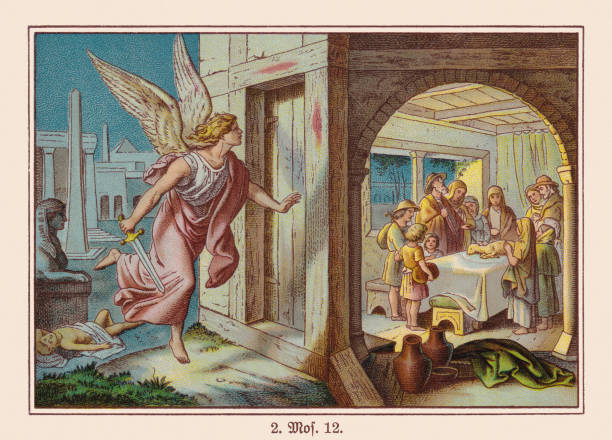
“At midnight the Lord struck down all the firstborn in Egypt, from the firstborn of Pharaoh, who sat on the throne, to the firstborn of the prisoner in the dungeon, and all the firstborn of the livestock.” — Exodus 12:29
That most horrific night in Egypt when the tenth and final plague hit, the nation groaned beneath the weight of God’s judgment. The cries rose in every home where fear had not met obedience, every home where the Word had not been trusted.
Mothers collapsed in grief, weeping over sons who would never again awaken; sons who would never again take another breath. Never again open sleepy eyes and smile expectantly at the dawn of a new day.
Loving hands that had brushed hair from sleeping foreheads only hours before now clutched the lifeless bodies of the children who had nursed at their bosom; those same hands now grabbed their children and shook them, screaming & begging for them to awaken.
Fathers stood frozen in doorways, unable to change what was happening before their eyes, unable to turn back time and shield what they had failed to protect, what they loved most. The deafening screams of their wives the only thing tethering them at that moment to their nightmarish reality.
All across Egypt, the night filled with wailing, the land filled with mourning. From the highest palace chambers to the lowest prison cells, the same horror unfolded. Firstborn sons —heirs, hopes, legacies—lay lifeless in their beds. No wealth could intervene. No authority could bargain. No strength could prevail. Death, in tragic abundance, had made itself known this night.
Cries poured out into the streets, rising and falling like waves, colliding with one another until the entire nation seemed to groan as one; one agonizing scream could not be separated from another. Mothers tore their garments. Fathers beat their chests. Neighbors clung to one another in terror, listening as grief echoed from house to house, realizing with dread that they were not alone —and that no one had been spared.
Only hours earlier, Egypt had gone to sleep as it always had. Lamps were lit. Children were fed. Families settled into the familiar rhythm of night. No one imagined that by morning, silence would replace laughter in so many homes; that death would replace young and promising life. This was not a distant judgment. It was personal. It lay cradled in mothers’ arms and stretched out on blood-warm floors. It was felt in the hollow ache of fathers who could not trade places with their sons, no matter how desperately they wanted to. Death had passed through the land on a large, sudden scale, and it had taken what mattered most.
And yet —this night did not arrive without warning. This devastation did not come without instruction, nor did it fall without an offered escape.
Long before the cries pierced the darkness, God had spoken. Long before death crossed Egypt’s threshold, a way had been given to stop it at the door. An answer. A solution. Hope. The loss of the firstborn was not inevitable. It did not have to happen. Before midnight ever struck, before the Angel of Death moved through the land, God delivered His command through Moses. Every household was told exactly what to do —plainly, specifically, without ambiguity.
“Then they shall take some of the blood [of a lamb] and put it on the two doorposts and the lintel of the houses in which they eat it…The blood shall be a sign for you, on the houses where you are. And when I see the blood, I will pass over you, and no plague will befall you to destroy you.” — Exodus 12:7, 13
A lamb without blemish was to be slain. Its blood was to be brushed upon the doorposts and the lintel (the entrance to the home). And when judgment came, it would not ask who lived inside. It would not ask what language they spoke, what status they held, what god they served, or what they believed. It would look only for the blood.
Where the blood was present, death would not enter. Where it was absent, judgment would fall. And in this was the pattern set long before Calvary. For the blood on Egypt’s doorways was but a precursor to a Lamb far more precious —a prophecy written in blood, a King foretold since the beginning of time.
Judgment came that night —but it did not fall upon homes that heeded the warning and obeyed; homes where the blood had already been shed. The lamb died so the firstborn would not. Life was spared because another life had been given in its place.
And it is exactly the same now. When Yeshua (Jesus Christ) —the spotless Lamb of God— was lifted up and slain, His blood, too, marked a doorway. Not of wood and stone, but of hearts and souls. And when judgment comes, it does not ask who we are, what we have done, how moral we appeared, or how religious we sounded. It looks for the blood. Those covered by the blood of the Lamb are not spared because they are innocent, no no no. They are spared because judgment has already fallen. And it was Christ that took that judgement. Fully. Finally. In their place.
But where the blood is refused… where the sacrifice is rejected… where obedience is withheld… where self reigns supreme… judgment remains.The same God who made a way through the blood in Egypt has made a way through the blood of His Son. The offer is the same: protection through obedience, life through sacrifice, mercy through faith.
The difference is this —in Egypt, the lamb died so the firstborn could live. At Calvary, the Firstborn died so that we, His lambs, could live.
But Egypt stood on the other side of that revelation. They did not yet see what we now see. There was no cross on a hill outside Jerusalem. No empty tomb. No risen Savior proclaimed to the nations. There was only a command… and a choice. On that night in Egypt, obedience did not come wrapped in full understanding. It came wrapped in trust. To mark a door with blood was not merely an act of survival —it was a declaration. A confession that Egypt’s gods could not save. A rejection of the powers they had long trusted to guard life, lineage, and legacy. And that is why this plague struck so deeply. For the death of the firstborn was not only judgment upon a people —it was judgment upon the gods Egypt had depended on to protect what mattered most.
For generations, Egypt had entrusted its most sacred hopes to its gods. Life, fertility, protection, legacy, and the future were all believed to rest in divine hands other than Yahweh’s. Mothers prayed to them. Kings ruled in their name. Entire systems of power and identity were built upon their supposed protection. And on this night, every one of them failed.
Osiris (oh-SIGH-ris) —god of life, death, and the afterlife— was believed to govern resurrection itself. He was worshiped as the one who granted renewal beyond the grave, who held authority over the fate of souls. Yet death moved freely through Egypt that night, unrestrained and irreversible. There was no resurrection at dawn. No restoration. Where life once breathed, silence now reigned.
Isis (EYE-sis) —goddess of motherhood, fertility, and the protector of children— was revered by mothers seeking safety for their sons. She was believed to shield families and guard the vulnerable. And yet, on this night, her temples echoed with unanswered prayers. Mothers wept while the goddess of maternal protection stood powerless to save even one firstborn.
Even Pharaoh himself —regarded not merely as king but as divine, the living embodiment of Horus—was exposed. His authority did not command mercy. His bloodline did not grant exemption. His palace did not provide sanctuary. The god-king of Egypt watched death enter his own household first, proving that his power was an illusion when measured against the command of Yahweh.
And Apis (AY-pis)—the sacred bull, symbol of strength, fertility, and life-force—could not protect what was under his domain either. The livestock of Egypt fell alongside the children of the land, revealing that even the gods of vitality and prosperity were helpless before the true God of life.This plague stripped hearts bare.This plague stripped *Egypt* bare.Not one god intervened.Not one prayer altered the outcome.Not one idol shielded its worshippers from judgment.The message was unmistakable:Egypt’s gods could *promise* life—but they could not *preserve* it.They could *demand devotion*—but they could not *deliver salvation*.On that night, Yahweh alone proved Himself sovereign over life, death, and everything in between.
The Bible does not linger over Pharaoh’s private anguish. It does not chart each thought, each tear, each faltering step he took in the dark.
And yet, it is not hard to imagine: a father, a king, a man unaccustomed to helplessness, confronted with the silence of his firstborn. We can feel the weight, the shock, the grief —the unspoken cries that echo in the chambers of a shattered heart.
Now, imagine: the palace halls stretched endlessly before him, cloaked in darkness, every shadow amplified by the flicker of dying lamps. The air is heavy, thick with the smoke of spent torches, the silence punctuated only by the soft, stifled sobs of servants. His son… his firstborn… the heir to his throne, the continuation of his lineage… lay lifeless, untouched by the power and wealth that had, until now, made Pharaoh untouchable. For the first time, mortality pressed against him like an iron weight. No walls, no guards, no gold could shield him. His authority meant nothing here. His gods offered no reprieve. All that remained was grief in its rawest form, a grief so piercing it could rend even the most hardened heart.
And in that moment, shattered and numb, the king —once relentless, unyielding— spoke words he might never have imagined uttering: “Go… take your people and leave.”
Exhausted. Numb. Shattered. The empire trembled not under foreign armies, not under rebellion —but under the loss of a child, a son, a future. Obedience, forced from the heart at last, carried with it the bitter sting of unimaginable sorrow.
Of course, we know that is not the end of the story. In moments of deep grief such as Pharaoh —and all of Egypt— were going through, emotions come and go in waves. And when the numbness lifted, anger set in. Pharaoh and all his men would go after Moses and the Israelites. But that is another story. Another lesson. Another post.
As for this post, the lesson is this: obedience matters, even when we do not understand the full plan. God’s commands are never arbitrary. His instructions are never for nothing. Just as the Israelites marked their doors and were spared, so too are we called to trust, to obey, to walk in faith, even when the outcome is unclear.
We are reminded that no worldly power, no wealth, no influence, no idol or false promise can protect us from the consequences of sin. Only the hand of God, only His provision, only His mercy —offered through the blood of the Lamb— can shelter us, can save us.
And remember, trust often comes in the midst of chaos —amidst the frogs, the blood in the Nile, the boils on skin, and the darkness that seems impenetrable. Faith does not wait for comfort or clarity. Faith obeys in the middle of mess, in the middle of suffering, in the middle of confusion, because God’s ways are higher than ours. Just as Pharaoh faced the unbearable weight of loss, we are called to recognize that God’s ways are just, and His mercy abundant —but it must be accepted, it must be embraced. Obedience is not about understanding every detail; it is about trusting the One who does.
Let this night in Egypt echo in our hearts: the stakes are real, the warning is clear, and the path to life has always been given. Mark the door to your soul with the blood of the Lamb; and by so doing, choose Life. Choose obedience. Choose trust —even when the world around you is plagued with pain and uncertainties.
╔════════════════════════════════╗
☩ One Cup. One Christ. One Calling. ☩
— Sunday Morning Coffee and Christ. —
╚════════════════════════════════╝


Leave a comment