Today’s passage: Joshua 10:12–14
The Bible tells of many battles — stories of courage, of conquest, of divine deliverance. But there’s one in particular that I want to talk about today.
Now, the battle I want to discuss wasn’t the largest in Biblical history. Nor was it the bloodiest.
It wasn’t Israel’s most desperate hour. It wasn’t men facing giants, it wasn’t three hundred against three thousand, and walls didnt come crumbling down at their feet and all around them in a thunderous victory.
No — what made this battle extraordinary was that, for the first and only time recorded in Scripture, God took direction from man.
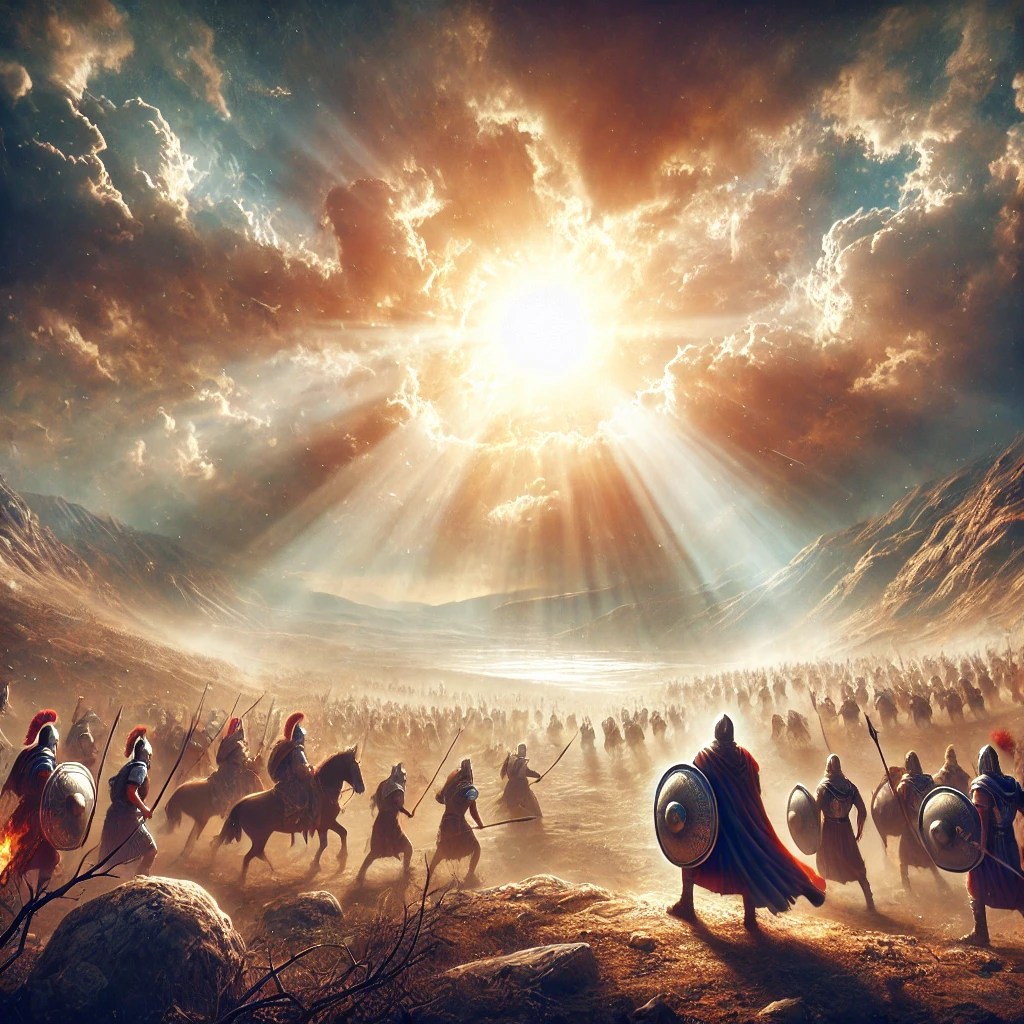
Get your historical time-caps on, because I want you to really picture this —Joshua and his army were fighting the Amorites: five kings and their united forces who had risen against the city of Gibeon, an ally of Israel.
At dawn, Joshua’s troops had marched all night from Gilgal, catching the Amorites by surprise. God threw their enemies into confusion, and Israel pursued them relentlessly.
But by afternoon, the battle stretched across miles of rugged terrain. The sun was sinking low. Daylight was fading fast.
In Joshua’s day, thousands of years ago, warfare depended heavily upon visibility. Without torches bright enough to light the field, without any sort of night vision to help guide them, darkness meant danger. Once the sun slipped beyond the horizon, confusion reigned — and we know our God is not a God of chaos or confusion.
In the dark, you couldn’t tell friend from foe. Swords might strike, and drip with the blood of a brother instead of an enemy. Wounded men would go unnoticed, left to suffer or be stumbled over by those still fighting. And hidden in the shadows, the enemy could retreat, regroup, and strike again at dawn while God’s people were weary from searching through the night.
Joshua knew that if darkness came before the battle was won, the victory God had promised would be delayed.
He wasn’t afraid of losing the fight — God had already guaranteed the outcome. But if night fell too soon, the enemy could scatter into the hills, regroup under cover of darkness, and strike again at first light. More lives could be unnecessarily lost before the promise was fulfilled — brave men cut down not from lack of faith, but from lack of light.
So, standing in the heat of war, between a fading day and a half-finished promise, Joshua did something few would ever dare to do.
The air trembled with the clash of swords and the cries of battle. Dust rose like smoke across the valley. Sweat and blood streaked his armor.
And yet — amidst the chaos, Joshua lifted his eyes to the heavens. While others swung swords all around him, he swung his belief upwards and spoke into the sky with the authority that only comes from one with unshakable faith; With faith that could move not just mountains, but time itself, and he cried out —
“Sun, stand still over Gibeon,and moon, in the Valley of Aijalon.”
And Scripture says: “The sun stood still, and the moon stopped,till the nation avenged itself on its enemies… There has been no day like it before or since, when the Lord heeded the voice of a man.” ~Joshua 10:12–14
I hope you haven’t taken those caps off yet, because there’s still more history to envision.
The battlefield, frozen in golden light. The sun — high and unmoving — hung above Gibeon like a blazing crown over a field of dust and sweat. Shadows that should’ve stretched and lengthened, remained still. Time itself lingered, suspended in awe at the authoritative command of faith. Every breath of wind seemed to hold its note, as if creation were waiting — waiting for God’s promise to finish what it had begun.
The clang of swords still rang through the air, but now under a sky that refused to dim. Warriors lifted their eyes, squinting in disbelief, seeing no sign of dusk. The moon itself halted, caught between heaven and horizon.
Day did not fade.
It obeyed.
The universe bowed to the voice of a man who believed his God could stop time if it meant fulfilling His word; believed his God would stop time, before breaking His word.
Because that’s what this was — not arrogance, not pride — but trust. Unrelenting, all-consuming, mountain-moving, time-stopping trust.
Joshua didn’t ask for daylight because he doubted God’s promise. He asked because he believed in it so much that he refused to let time run out before seeing it come to pass.
And so, for one breathtaking moment in all of history — the created paused for the Creator’s friend. A day that refused to end until victory was complete.
Because even time itself bends to Yahweh — our Adonai — the Lord of sun, moon, and man alike.
This event — this unthinkable pause in the heavens — has fascinated believers, skeptics, and scholars alike for centuries. How could the sun and moon “stand still”? What really happened that day?
Some read it exactly as it sounds — a miraculous, supernatural suspension of the natural order, where the earth itself halted in its rotation by the very word of God.
Others believe it may have been a natural phenomenon that God perfectly timed to accomplish His will.
And me, personally, I think that both ideas hold an awe-inspiring kind of wonder.
Because God is the Author of both the natural and the supernatural. The Maker of science and the Master of miracles. He doesn’t break His own design to display His glory — He commands it. And if He so desires, He can weave the natural and supernatural together to achieve what He wants achieved.
There are a few fascinating theories people have suggested through the years:
1. A Miraculous Prolonging of Daylight: The plain, surface-level reading of the text suggests that God supernaturally extended the day itself — that the rotation of the earth (or the appearance of it) was paused. Such an act would require total command of cosmic order — and that’s the point. It was not nature acting on its own, as it does day after day after week after month after year after decade after century and on and on always. It was God bending the universe to fulfill His word; taking the laws of time and space that He created, and, as their Creator, making them STOP.
2. A Solar Eclipse Theory: Some scholars note that the Hebrew word translated “stood still” (dom) can also mean to be silent or to cease shining. In that case, the passage could refer to an eclipse — the sun darkened, the moon visible, a divine sign during battle. Interestingly, scientists at Cambridge University identified an annular solar eclipse visible in Canaan around October 30, 1207 B.C. — right around the estimated time of Joshua’s campaign.
3. A Miraculous Refraction of Light: Others have proposed that God could have caused light to linger — perhaps through atmospheric refraction or a phenomenon beyond our current understanding — extending the appearance of daylight without halting the planets themselves.
However it happened — whether through divine command outside the laws of physics or through His sovereign timing within them — the truth remains the same: God moved heaven and earth to fulfill His promise. Joshua asked in faith, and heaven responded.
Whatever the mechanism — the miraculous pause, an eclipse, or an atmospheric phenomenon — the awe remains.
And here’s one great thing about these, and any, theories, postulated: there’s no single “correct” answer that we have to argue over!
What I, personally, think happened, is that God, in His infinite wisdom, orchestrated the event in such a way that both science and the supernatural could intersect. It could be seen as an observable supernatural act — God directly pausing the day — but it could also be seen in a way that lines up with nature, so that if someone who knows enough about science and the world, studies it carefully, they can find scientific evidence to back up what happened.
Again – He arranged the laws of creation so that the miracle could be observable, perhaps even measurable, by those who study the natural world — and yet, it was, quite obviously – to me, anyway – still a miracle.
Think of it like the plagues in Egypt. Each one unfolded in a way that followed natural principles — yet they were undeniably acts of God’s power, each step revealing His sovereignty and not only defeating, but mocking, the false gods of that land. The scientific elements don’t diminish the miracle; rather, they magnify it.
You can see the logic of how and why each plague followed the one before it — yet every step was planned and controlled by God. The timing of them, them appearing on command, each one affecting only the Egyptians, these all showed His power and proved that He is the one true God. Just because we can see how nature works doesn’t mean God wasn’t behind it. In fact, it shows how smart and creative He is, using the world He made to accomplish His purposes.
Just like the plagues, the stopping of the sun and moon in Joshua’s day shows God’s perfect combination of power, wisdom, and timing.
In Egypt, He worked through natural processes to achieve His miraculous purposes. At Gibeon, He worked directly with creation itself, bending time and light to fulfill His promise.
Both stories remind us of the same truth: God is never limited by the laws He created. He can act within them or beyond them, and in both cases, His hand is unmistakably at work.
The supernatural, and the natural, miracles and science, can coexist, each pointing to His glory, each displaying His intelligence and creativity. And just as with the plagues, we don’t need to have every detail figured out to marvel at His work. What matters is that we see His power, we trust His promises, and we allow our hearts to be amazed by the God who moves heaven and earth for His people.
If somebody reading this doesn’t agree with me on what I think happened, if they lean toward the eclipse theory, or if they believe it was 100% supernatural and can’t be explained at all, that’s completely fine! That’s more than fine, actually, it’s wonderful. I am thrilled they’re thinking about it at all, thinking about it enough to have a theory and disagree with me — pondering the story, imagining what could have happened, giving it credence that it did, in fact, happen…
That’s what I really want from sharing this post. And their theory –your theory, possibly– just might be the correct one. I might absolutely be wrong in how I think it occured.
I’m not writing this post to claim I know exactly how or why it happened. What I am saying is this: God is amazing. He performs miracles. Sometimes those miracles can be traced through scientific methods and seen to have natural explanations. Sometimes they can’t. Or maybe they all can and we just haven’t figured them out yet.
Even if we can explain them scientifically, that doesn’t make them any less miraculous. The timing, the precision, the way everything aligned perfectly — that was God.
He arranged the laws of creation to work for these miracles, or to allow them to happen in ways we can’t yet comprehend.
And on the flip side, if nothing about them can be explained scientifically, that doesn’t make them impossible either. God can work both within His creation, and beyond it. I think we should get together and discuss these stories more often — the miracles, the timing, the characters — because it helps us understand better the Bible and the people within it.
Even if we can’t know every how or why, we still learn about God and His people by thinking and talking about it together. Gaining other believers perspectives is typically a tremendous help in understanding, and in flaming that fire within us, which is so incredibly important!
And here’s a very important part, a part that, sometimes, some people, need a gentle reminder about: we don’t have to agree on the hows. We don’t need to fight about who’s right or who’s wrong. The only thing we need to agree on is Yeshua, Jesus Christ — that He lived and died for us, and three days later rose from the grave.
Giving our hearts and lives to Him, with love in our hearts, always trying to draw closer to Him, is what unites us, it’s what makes us family. Everything else — the hows, the mechanics, the timing — that can all be disputed until the end of time, as long as the discussion is done with respect, love, and faith.
So what do we take from all of this? Whether the sun actually stood still, whether it was a natural phenomenon, or whether we’ll never fully understand the mechanics — the lesson remains the same. God is in control. His timing is perfect. His power is limitless. And His ways are far beyond our full understanding.
These stories — Joshua’s bold faith, the plagues in Egypt, and so many others — remind us that God works in ways both predictable and mysterious, within creation and sometimes beyond it.
He invites us to marvel, to explore, and to discuss.
He calls us to faith that trusts Him even when the how is unclear.
And, again, we don’t have to have all the answers. We don’t have to agree on the exact mechanics of every miracle.
We just need to agree on Him.
So take a moment to let these stories sink in. Let them inspire awe, spark curiosity, and ignite faith.
Think about the courage of Joshua, the wisdom of God in Egypt, and the miraculous ways He moves heaven and earth for His people.
And remember: every discussion, every question, every “what if” is a step closer to understanding the God who created time, light, and life itself.
He created Joshua who called up to Him boldly in faith, He created me, and He created you. Beautiful, wonderful, glorious you. And I am so excited about meeting you one day in Heaven, giving you a hug, and maybe even sharing a cup of coffee together while we talk about how amazing our God truly is.
╔════════════════════════════════╗
☩ One Cup. One Christ. One Calling. ☩
— Sunday Morning Coffee and Christ. —
╚════════════════════════════════╝


Leave a comment