The Why Behind the Wrath
Before the first plague ever struck the sands of Egypt, amidst all the noise of empire and ambition, there was silence — the kind that can only be heard if you walk amongst the broken; the kind that follows centuries of suffering.
God’s people had cried out from beneath the weight of chains, their backs bent beneath Pharaoh’s monuments of pride; and lost within the shadow of his monumental ego. Egypt’s wealth gleamed, its temples rose, and its gods multiplied — but the cries of the enslaved rose higher still, echoing in the ears of the Almighty.
The Almighty heard….and the Almighty acted.
The plagues were never senseless acts of rage. They were the righteous response of a holy God who had been mocked, defied, and ignored. A nation had exalted itself above mercy, had turned human lives into currency, and had hardened its heart against compassion.
The judgment that followed was not born of cruelty, but of covenant — a promise kept to a people forgotten by men, but remembered –and cherished– by the Maker of men, God Himself.
Long ago, God had foretold to Abraham that his descendants would be strangers in a foreign land, and for 400 years would there dwell.
But with that foretelling, He also promised that He would deliver them with mighty judgments, punishing the nation they served (Genesis 15:13–14).
And now, the hour had come for God to act, and to fulfill that promise — and in that fulfilling, every false god would be humbled and every idol laid low.
For Egypt, that movement would mean devastation. For Israel, it would mean deliverance. And for us, millennia later, it still means God’s wrath is not random — it is righteous. His justice is not cruel — it is holy. His deliverance is not delayed — it is perfectly timed. And for His children – we shall never be forsaken, for His faithfulness is as certain as the rising sun, and His covenant endures beyond the ages.
The Ten Plagues: More Than Meets the Eye
First, I want you to sing ‘The Ten Plagues: More Than Meets the Eye’ to the melody of ‘Transformers – More than meets the eye’. OK, thank you for that. Now we can go back to being serious, and theological.
Seriously theological.
The story of the ten plagues is often told as if each one were simply a historical footnote, a passing display of divine power. Something to definitely take note of, but not something worthy of deep inspection.
These events, however, were far deeper, far more deliberate, than most of us are ever taught.
They were not mere judgements picked out at random and haphazardly thrown about Egypt. Each plague was a carefully orchestrated sign — a revelation of the futility of Egypt’s gods, the weight of Egypt’s sin, and the glory of the One True God.
These plagues did not occur in isolation. Each one built upon the last, a carefully measured escalation of judgment and revelation. The Nile turning to blood made the water undrinkable, forcing the frogs to leave the river and invade the land — their departure and death would lead directly to the next plague, the swarms of pests. The decaying frogs became the breeding ground for these pests, whose relentless bites and infestations brought further suffering — setting the stage for the following plague, the painful boils upon man and beast. And so it continued with each plague.
Each subsequent plague unfolded in this manner, step by step, as though God had set a ladder across Egypt, each rung revealing both the fragility of the Egyptians’ gods and the inescapable righteousness of Yahweh, the One True God. Though Pharaoh and his people were forewarned by Moses of what they would face at each step, before they faced it, they could not have anticipated the enormity of these cascading effects; what modern science may now explain, was utterly unforeseen in that day, leaving the Egyptians powerless before the God of Israel.
That is why each plague deserves its own story, its own reflection, and its own post to be fully understood, fully recognized, and fully respected.
In this series, we will examine them one by one, beginning with the first…
Plague 1: Blood in the Nile
The first plague was not merely a physical event; it was a direct confrontation with Egypt’s gods, chief among them Hapi (HAH-pee), the god of the Nile, revered as the source of life and abundance. The waters that gave Egypt wealth, food, and civilization would become the stage on which the impotence of these gods was revealed.
God’s Word alone had the authority to command the river, striking down Egypt while sparing His chosen people. God would make it known that no made-up “god” of life –or of anything– had any actual power or control over anything at all.
Only Yahweh, the Creator of the universe, of Egypt and the Nile itself, had any say over what happened.
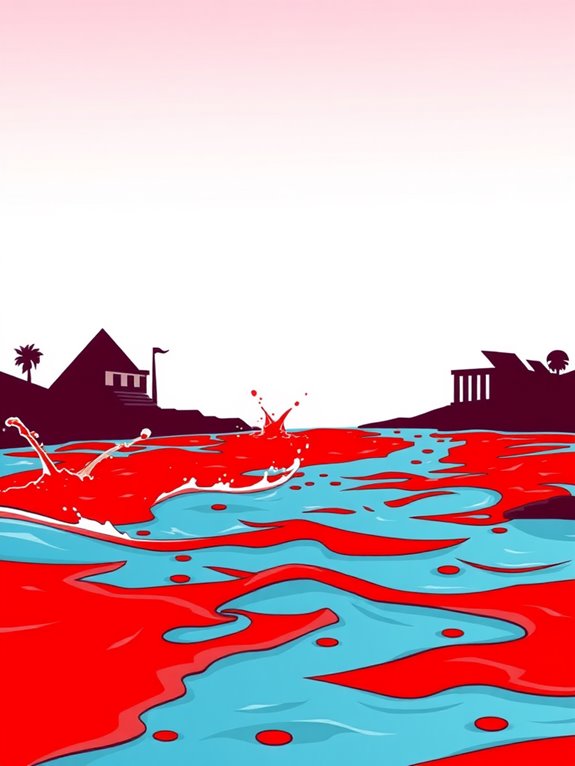
The first sign of God’s judgment was simple in description, yet catastrophic in impact: the waters of Egypt were turned to blood (Exodus 7:14–24). What had sustained life for centuries — the Nile, Egypt’s lifeline — became death itself. Fish perished, the water grew foul and undrinkable, and the land reeked of decay.
To the Egyptians, the source of their wealth and survival had become a curse. Their gods, Hapi and the many deities of the Nile, were powerless against it, exposed as false and impotent before the One True God.
To explain this first plague, scholars and scientists have proposed natural explanations: red algae blooms, mineral contamination, or even volcanic activity that could have temporarily colored and poisoned the river.
Yet whatever the mechanism, the miracle lay not only in the transformation itself, but in its timing, its scope, and its selectivity — striking Egypt while sparing Goshen, the land of the Israelites. The water became death for some, and deliverance for others, a tangible symbol of God’s justice and His covenantal care.
The effect was immediate and profound.
The fish died, cutting off one important source of food for the city.
The water became undrinkable, forcing women to dig and search for other sources to sustain their families.
The stench of decay permeated villages and cities alike, causing nausea and distress wherever it reached.
Humans and livestock all suffered thirst; animals used for both food and labor weakened and died.
Egypt’s entire economy was at stake; dependent upon the river for irrigation, trade, and survival, it began to crumble. Their wealth, power, and very livelihood hung in the balance.
And as the frogs fled the poisoned water, thus began the chain of events that would lead directly to the second plague.
What seemed like simple water, a river that had always been there and which was taken for granted that it always would be, now stood as a divine warning — a first rung upon a ladder of judgment, each step exposing the arrogance of Pharaoh, the impotence and futility of Egypt’s gods, and the unmatched sovereignty of the God of Isreal.
Pharaoh’s response was predictable yet tragically stubborn. He summoned Moses and Aaron to his palace, demanding relief and questioning how a single God could wield such power over Egypt’s greatest river. Moses reminded Pharaoh of Yahweh’s authority and that he had been forewarned of the calamity that had befallen them, yet Pharaoh’s heart remained hardened.
Finally, in desperation, he asked Moses to pray to God to remove the plague. At Moses’ intercession, Yahweh relented, and the waters of the Nile returned to their natural state. The water became drinkable once more, and life along the river began to resume — but the lesson was unforgettable.
The Egyptians had witnessed firsthand that Hapi, their god of the Nile and of life and abundance, was powerless. The miracle had struck both as judgment and as revelation: Yahweh alone is sovereign, His Word unstoppable, and His promises fulfilled.
Though Pharaoh temporarily relented, history shows his compliance was fleeting. The hardened king would soon refuse to obey, setting the stage for the second plague. Yet for the Israelites, the waters had remained safe — a visible sign of God’s protection and a reminder that deliverance comes to those who belong to Him.
Evidence for the Plagues
While some dismiss the plagues as myth, there is compelling evidence that suggests these events have real historical grounding.
Ancient Egyptian records, though sparse in explicit references directly to the plagues, document periods of famine, sudden ecological disruption, and social unrest that align with the biblical account. Inscriptions and papyri note abnormal river conditions, fish die-offs, and the movement of populations along the Nile during certain periods — details that resonate with the narrative in Exodus. Archaeological studies of the Nile delta reveal layers of sediment, microbial activity, and signs of environmental stress consistent with sudden natural phenomena. Fish bones and shells indicate episodes of mass death, and remnants of settlements show signs of temporary abandonment or emergency adaptation, suggesting a society under pressure.
Additionally, historical writings outside the Bible occasionally record strange occurrences in Egypt, such as sudden red-colored waters or livestock die-offs. While these accounts do not name Yahweh, they corroborate that Egypt experienced extraordinary environmental events.
Together, these pieces of evidence paint a picture of a land subjected to unusual and devastating phenomena — the backdrop for the first of many divine judgments recorded in Scripture.
While historical and archaeological evidence points to the plagues as real events, the mechanisms behind them invite further exploration. For those who need scientific study to consider anything to be fact, scientists and scholars have proposed several natural explanations for how these extraordinary occurrences may have unfolded — explanations that, even when understood, do not diminish the divine purpose or precision behind them.
Scientific Theories Behind the First Plague
1. Red Algae (Toxic Algal Bloom): One compelling scientific theory suggests that a massive bloom of red algae could have turned portions of the Nile a deep crimson, killing the fish, contaminating the water, and causing a strong stench of death and decay along the riverbanks. Importantly, it would not need to cover the entire river — only the areas near Pharaoh and the Egyptian cities — to create catastrophic disruption. Modern observations confirm that under the right conditions, red algae can produce these effects, lending credibility to the theory of red algae.
Though Scripture does explicitly say that the river was turned to “blood,” The Hebrew word used, דָּם (dam), can mean either literal blood or water that appears as blood. This allows us to still see Gods Word and the biblical description of the plague as fully true whether He transformed the water supernaturally into literal blood or He allowed a natural phenomenon to cause the river to merely appear as blood. Either way, the effect was the same — a miraculous judgment upon Pharaoh and a clear demonstration that Hapi, the god of the Nile, was powerless against Yahweh.
2. Mineral Contamination: Another proposed explanation for the first plague involves sudden contamination of the Nile with minerals, particularly iron oxide or other naturally occurring elements. Under certain geological or environmental conditions, minerals can be washed into rivers through upstream flooding, erosion, or seismic activity, temporarily turning water reddish and affecting aquatic life. In some cases, the water can become toxic to fish and other creatures, and unfit for human consumption.
Scientists and historians point out that the Nile flows through regions rich in iron and other minerals, and that periodic flooding or geological shifts could have released these elements into the river. Some studies note that heavy rainfall or sediment displacement can result in localized discoloration and temporary ecological disruption. While modern observation can show that mineral contamination can kill fish and change the color of water, the experts emphasize that it would require a remarkable combination of events to match the scale described in Exodus.
This explanation demonstrates that there is a natural mechanism capable of producing the effect, but as with all the plagues, the extraordinary aspect remains: the water turned red precisely when God commanded it, it struck Egypt but spared Goshen, and it lifted only after Pharaoh summoned Moses and pleaded with him to pray for the removal of the judgement (which Moses did, and told Pharaoh precisely when the removal would occur).
So, as with any theory for the first plague, the mineral contamination theory may explain the “how” of the red water, but it cannot account for the divine precision and timing, which clearly point to God’s miraculous hand in the event.
3. Volcanic Activity: Some researchers propose that volcanic eruptions, either in Egypt or in nearby regions, could have triggered the events described in the first plague. Volcanic activity can release ash, chemicals, and minerals into the atmosphere and waterways, sometimes causing rivers to appear discolored, fish to die, and water to become unsafe for drinking. Historical records show that eruptions have caused sudden environmental disruptions in other parts of the world, making this a plausible natural contributor to the Nile’s transformation.
Experts note that even a distant eruption can affect weather patterns, river chemistry, and local ecosystems. For instance, volcanic ash can increase the acidity of water, deplete oxygen, and introduce iron and other elements that kill fish and contaminate drinking sources. Scientists suggest that such an event could produce a red or murky river over localized areas, fitting with the biblical account where the effect was concentrated near Egyptian settlements.
But again, even if volcanic activity played a role, the miraculous remains unmistakable. The water turned red exactly when God commanded it, struck Egypt but spared Goshen, and lifted only when Pharaoh summoned Moses and obeyed God’s instruction for its removal. No natural phenomenon alone could account for this precise timing, selectivity, and orchestration — elements that point clearly to the hand of Yahweh in judgment and deliverance.
4. Literal Blood: Finally, another long-standing interpretation is that the Nile and its tributaries literally turned to blood. Whether that was human or animal blood matters little; the point is that this plague involved actual blood, not merely something that looked like it. This view is often supported by the straightforward reading of Exodus 7:17–20, which plainly states that “the waters… were turned to blood.”
Those who hold this interpretation argue that when Scripture describes something so directly and repeatedly, it should be taken at face value unless the text itself suggests otherwise — such as a metaphor or figure of speech — which it does not in this case.
(This, however, does not take into account that the original Hebrew word does not absolutely mean the river was turned to literal blood. It could mean that, but it can also refer to water that merely appeared as blood.)
Furthermore, blood as the chosen element carries deep symbolic meaning throughout Scripture. It represents both life and death — the life that belongs to God alone (Leviticus 17:11) and the judgment that follows when that life is taken or defiled.
In this view, there is no scientific theory that can explain what happened. If this interpretation is correct, we cannot rely on past natural phenomena to guide our understanding of the event. Yet whether the river was turned into literal blood or appeared as such, every interpretation allows for no less of a miracle. The timing and scope were divinely precise — striking Egypt but sparing Goshen, beginning and ending at the command of God through Moses. Scientific explanation or not, it most certainly included the supernatural, the divine, the holy — for it was the Holy One who orchestrated it, who timed it, and who lifted it.
Only an all-knowing God could have designed such a judgment that worked both naturally and supernaturally in perfect harmony, one act flowing into the next with flawless precision. No matter the mechanism, the message was clear: Egypt’s gods were powerless, and Yahweh alone reigned sovereign.
The first plague, then, opened the floodgates — not of water (or of blood), but of divine reckoning. What began with blood would soon give rise to frogs… and with them, the next movement in God’s symphony of judgment and deliverance.
☩ One cup. One Christ. One calling. ☩
Sunday Morning Coffee & Christ
Author’s Note: Ancient Egypt had hundreds of deities whose domains often overlapped and varied between regions and time periods. Because of this, scholars differ on which specific god—or gods—each plague confronted. The deities mentioned in this study reflect widely supported interpretations, though they are not the only possible identifications.
What remains certain, however, is the theological purpose: Yahweh struck at the very heart of Egypt’s worship, exposing the impotence of every idol that claimed authority over creation. The names may differ among historians, but the message does not: no false god could stand before the God of Israel.
For a list of sources and references, visit the [Sources page]. Because truth isn’t afraid of being questioned and studied.


Leave a comment