As the last of the flies fell lifeless across Egypt, the buzzing chaos that had swarmed every corner of Pharaoh’s kingdom faded into an eerie placidity. The air, recently thick with black wings and stinging darkness, settled into a silence heavy enough to make the land hold its breath. Yet judgment does not sleep—and mercy unheeded becomes warning intensified. For just as the people scraped the remnants of Plague Four from their homes, fields, and altars, another shadow crept across the horizon—one that would not come with a sound, but with a stillness far more terrifying; for in place of flying, this warning would have no movement at all.
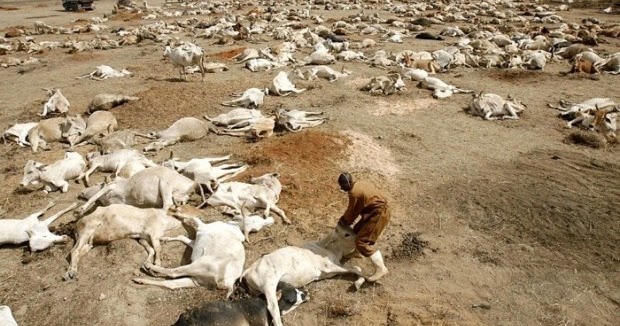
It began at dawn, when the herds—usually restless with morning hunger—stood unnaturally still. Heads drooped. Breath labored. Eyes dulled. Farmers called out to their cattle, but the animals did not stir; even the sacred bulls of Apis, tended with ritual precision, swayed as if caught between this world and the next. What Plague Four had assaulted with noise, Plague Five struck with silence. A creeping sickness, unseen yet unignorable, swept through Egypt’s fields until the first bodies fell—heavy, final, and unmistakably divine in their judgment.
To Egypt, the collapse of livestock was more than an economic blow—it was a spiritual crisis. For among the fallen were the very beasts the Egyptians revered as living vessels of the divine. Apis (AY-piss), the sacred bull of Memphis, was believed to be the earthly manifestation of Ptah (p-TAH), a god of creation, and later linked to Osiris (oh-SY-riss), lord of the underworld. His sleek black form, adorned with ritual markings, symbolized strength, virility, and the divine power that sustained Egypt’s prosperity.
Not far behind him stood Hathor (HAY-thor), the cow-goddess of motherhood and nourishment, depicted with gentle eyes and curved horns—a deity believed to guard women, bless fertility, and pour out abundance upon the land.
Together, these gods embodied life, vitality, and the beating heart of Egypt’s agricultural wealth. Yet now, as bulls staggered and cows collapsed into the dust, the icons of Egypt’s protection lay powerless, unable to shield even themselves from the hand of the true God.
The devastation spread with merciless precision. Fields once alive with movement became graveyards of stillness. Oxen that had long plowed Egypt’s soil lay motionless beside wooden yokes, their massive bodies already stiffening in the rising heat. Wagons stood motionless where they’d been left, empty harnesses dangling like so many unanswered questions. Dust stirred around them, unsettled and restless, as if even the earth felt the sudden absence of movement, of life.
The stench of death gathered in waves—heavy, sour, inescapable—clinging to the air and settling into every fold of cloth. Children who once clung to their favorite calf now stood in doorways, eyes wide and wet, unable to comprehend why the creatures that fed them, clothed them, and carried their world had suddenly fallen silent. And in the markets, where the lowing of cattle had once echoed between stone walls, there was only emptiness—a vast, echoing quiet that felt like the land itself was grieving.
The Report On the Fields of Silence
Behold the scene as it likely unfolded:
Pharaoh on his throne, robed in royal splendor, while trembling officials approached—bearing tidings that would once again shape the very gods of Egypt. Their faces were drawn, robes dusty from hurried travel, and the reverence with which they usually entered the throne room had been swallowed up and replaced by urgency and dread. They bowed low, but their voices quivered as they delivered their report:
The fields were silent.
The herds were dead.
Not a single beast had survived.
The words fell like stones in the chamber, but Pharaoh’s expression did not crack. His jaw tightened; his fingers curled against the carved armrest. Behind his eyes, something smoldered—anger, denial, pride, perhaps all three. To admit devastation was to admit defeat. To acknowledge the plague was to acknowledge the God behind it.
And that, Pharaoh would not do. Even as the murmurs of his court rose around him —fearful, disbelieving, pleading— Pharaoh’s heart clenched harder. Reason crumbled beneath arrogance. Humility drowned in the rising flood of defiance. He would not yield.
He could not yield. Not to Israel. Not to Moses. Not to their God.
And so, unlike previous judgments, Pharaoh issued no plea this time. No summons for Moses. No request for prayer. No promise to relent. Even with the stench of death seeping through the palace walls…
Even with the agonized cries of grieving farmers rising from the fields…
Even after his own men confirmed that the God of Israel had drawn a perfect line around Goshen…Pharaoh’s heart calcified. He did not bow. He did not break. He did not even acknowledge that judgment had fallen.
The plague required no removal, for it accomplished its devastation in a single sweep, it was there and then gone — swift, decisive, and unmistakable. Once the livestock lay dead, the silence stood as its own indictment. And Pharaoh, wrapped in the brittle armor of pride, refused to humble himself under the mighty hand of the Lord. The land mourned. Egypt’s gods lay humiliated. Yet Pharaoh’s heart remained unyielding.
And so, with no repentance, no petition, and no turning of the king’s heart, the stage was set for an even harsher blow. The next plague would strike not the animals of the field… but the flesh of man himself.
Why This Judgment Fit Perfectly After the Previous Plagues
When you look closely, the sequence of God’s judgments carries a frighteningly precise logic — each plague setting the stage for the next, like a divine domino effect.
The Nile turning to blood (Plague One) killed the fish, and the putrefying river drove the frogs onto the land (Plague Two). When the frogs died in heaps, their decaying bodies created the perfect breeding ground for small pests—allowing gnats to swarm (Plague Three). Those gnats, along with the later infestation of flies (Plague Four), bit both people and animals, burrowed into wounds, spread parasites, contaminated feed and water, and blanketed the land with disease.
By the time Plague Five arrived, Egypt was primed for catastrophe. The insects had already done their work.
It started with a river becoming contaminated.
It continued with the frogs fleeing said river.
Then the frogs dying.
Pests swarming.
Pests biting.
Disease spreading.
Every ignored warning became the soil in which the next judgment grew. And the bacteria left behind by the gnats and flies — combined with the stench of frog and fish carcasses and the filth accumulating across the land — made Egypt’s livestock vulnerable to sudden, deadly infection. Ancient livestock, especially cattle, were already intensely vulnerable to diseases transmitted by insects as it was: anthrax, lumpy skin disease, Rift Valley fever, and other rapidly fatal illnesses.
What came next was no random disaster. It was the natural — and supernatural — result of mercy refused and warnings unheeded. And the bacteria from all that death… it only set the stage for what was coming next.
Historical Echoes: When Ancient Ink Sounds Like the Retelling of the Truth of Exodus
Scripture stands as the true and sufficient record of God’s judgment upon Egypt. Yet scattered across history are faint murmurs — fragments of ink, clay, and memory — that seem to echo the devastation described in Exodus.
They are not definitive proof, and scholars debate their dates, origins, and meanings. But if the plagues happened exactly as God said they did, then it should not surprise us if the world He struck still carries the scars.
One such whisper comes from a fragile Egyptian document known as The Ipuwer (EE-poo-wair) Papyrus— a text preserved on a single, weathered scroll now housed in the Leiden Museum in the Netherlands. It is often called ‘The Admonitions of Ipuwer’, a poetic lament written from the perspective of an Egyptian scribe witnessing his nation unravel. Its lines tremble with descriptions of disaster, mourning, reversal, and ruin — images so eerily close to the Exodus plagues that historians and theologians have debated it for more than a century.
The papyrus never names Moses, Israel, or the God of the Hebrews. It does not present itself as a chronological account of the ten plagues. But certain phrases leap from the page with haunting familiarity.
Ipuwer mourns that “the cattle are left to stray, and there is none to gather them” and elsewhere laments that “all animals, their hearts weep; cattle moan.” In another line he writes, “the land is without light,” and in yet another, “the river is blood.”
These lines, scattered across the lament, read almost like a shattered mirror reflecting the judgments of Exodus — not clear enough to be declared proof, yet too parallel to ignore.
Skeptics argue the papyrus describes a different period of Egyptian turmoil; supporters counter that the imagery is too specific, too layered, and too unusual to be mere coincidence. They point out that the papyrus portrays a nation suffering widespread collapse across social, agricultural, and religious lines—all in patterns that resemble the biblical account more than any other event in Egyptian history.
Some scholars note that Egyptian records often avoid recording defeats or humiliations, making poetic laments like Ipuwer’s the closest thing we have to historical honesty in a culture that preferred its monuments carved in victory. We’ve all heard the saying, “History is written by the Victors”.
Others observe that the papyrus reads not like myth or allegory, but like a desperate eyewitness cataloging disasters he does not understand — disasters that, if aligned with Exodus, would have unfolded in rapid and overwhelming succession.
In truth, no ancient document outside the Bible gives a perfect, uncontested account of the plagues. The Ipuwer Papyrus is not a smoking gun. But it is a cracked window into a world that once trembled beneath judgments it could not explain.
A world where cattle died en masse, where the Nile ran red, where chaos overturned the pride of a kingdom, and where Egypt cried out under conditions strikingly similar to those recorded in Exodus.
And so this fragile scroll remains —quiet, incomplete, debated— but whispering nonetheless. If nothing else, it serves as a reminder that God’s works do not evaporate into myth; they leave traces behind.
And sometimes, even the unbelieving world — scholars, archaeologists, poets of ages past — accidentally brush up against the fingerprints of the Almighty and wonder why the dust of history still chokes those alive and well in the modern age.
A Closing Reflection …and What’s to Come Next
Egypt had been struck in its waters, its fields, its temples, its pride, and its very gods. Judgment had drawn a hard line between those claimed by the God of Creation and those who stood in defiance of Him.
Yet still, Pharaoh hardened his heart. Still, he clung to idols that could not breathe, could not speak, could not save neither the bugs nor the bulls that bore their image. And so Egypt remained a land divided — light and life in Goshen, darkness and death everywhere else.
But the God who moves with purpose was not finished. For if the death of livestock shattered Egypt’s economy and crushed its religious confidence, the next blow would fall directly upon the skin.
What began with the blood of the Nile… what spread through gnats and flies… what culminated in the death of their animals……was about to strike the bodies of Egypt themselves.
The warnings had been heard.
The mercy had been offered.
The line had been drawn.
And yet Pharaoh refused.
Which means the next plague would not merely confront Egypt’s gods. It would not confront Egypt’s livestock. It would confront Egypt’s flesh.
╔════════════════╗
☩ ONE CUP. ONE CHRIST. ONE CALLING. ☩
— SUNDAY MORNING COFFEE & CHRIST —
╚════════════════╝
For a list of sources and references used in obtaining the information in this post, check out the Sources page. To find the sources referenced for this post specifically, press Ctrl + F and search for ‘Plague 5: False gods Stirred with the Death of the Herd’. Because truth isn’t afraid of being questioned and studied.


Leave a comment