Exodus 9:8–12
The land of Egypt had already begun to rot from the inside out. Blood had poisoned the waters… death had driven the frogs onto land… their decaying bodies birthed the gnats… the gnats summoned the flies…the flies carried disease into the livestock… and the diseased livestock carried infection into the people themselves.
Every plague had followed a grim, natural chain —a divine domino effect where each judgment grew out of the one before it. And now that chain reached the human body.
At God’s command, Moses and Aaron stepped before Pharaoh with handfuls of soot taken from the very furnaces where Israel had been forced to labor — the brick kilns that had burned beneath the whip of Egypt, where Israelite men worked endlessly through literal blood, sweat, and tears. God chose that soot, that symbol of Israel’s slavery, and commanded Moses to throw it heavenward.
This moment was deeply symbolic: it wasn’t just Moses throwing a handful of dirt into the air; it was Moses taking the evidence of hundreds of years of toil — the very dust of their bondage, the residue of centuries of cruelty — and lifting it up to God; offering up their past, their slavery, all their pain and suffering; their entire afflicted history into the merciful hands of the Almighty.
And the merciful Almighty took what Moses offered up to Him…
The instant that blackened soot of slavery was cast into the air, it was as though God breathed a righteous breath of judgment; and the soot rode upon that breath, spreading across Egypt like an invisible curse.
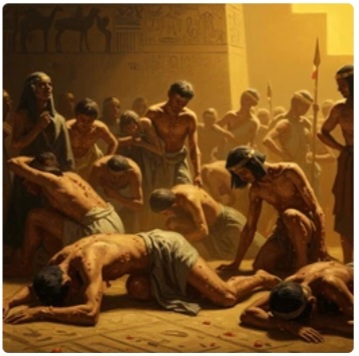
And as it settled, the people began to erupt in boils — deep, raw, and agonizing, breaking forth with blains. Painful ulcers rose upon the skin of man and beast alike, spreading with terrible speed, cracking open, burning, swelling… full of pus and blood… refusing to heal and causing intense pain.
Even Pharaoh’s magicians, once proud imitators of earlier plagues, could not even stand before Moses. Their bodies were debilliatated, so torn with sores that they collapsed under their own weight; undone by the very judgment that their arrogance once believed they could replicate.
And as his palace guards and magicians collapsed in agony, unable to stand before even two “lowly” Hebrew peasants, still Pharaoh’s heart remained hardened.
Judgment had, until now, come from without. Now it was coming from within..
Egypt had witnessed each disaster unfold like a relentless chain reaction — one natural consequence following another. Each plague left devastation in its wake, touching the land, the livestock, and the people alike, building a rhythm of judgment that could not be ignored.
This time, however, the judgment did not strike the Nile, or the soil, or the insects of the air. It struck the human body itself — the very vessel of pride, strength, dignity, and identity. Israel had been beaten with whips, scarred by sun and stone, bent beneath forced labor. And now Egypt would feel pain in their very flesh — not because God delights in suffering, but because God confronts a hardened heart with the only language it can still hear.
The boils were not only a physical agony, but a humiliation: the great empire that crowned itself in gold now found its priests, warriors, magicians, and nobles crawling upon the ground, covered in sores they could not hide and that would not heal.
This plague exposed: the frailty of human flesh, the emptiness of human pride, the limits of human power, and the foolishness of resisting a God who had already shown mercy five times before.
It revealed that a heart determined to defy God will cling to rebellion even when pain has stripped away every excuse. This plague was God’s interruption — His divine collision with Egypt’s self-confidence — meant to show that the One they dismissed was the only One who could heal what was breaking.
The Gods This Judgment Confronted
This plague did not simply strike the skin. Just like every plague preceeding it, it struck at specific false gods. And this one struck the very gods Egypt trusted to protect the body.
Boils and blains were a direct assault on several deities Egypt invoked for health, healing, purity, and protection.
• Sekhmet (SEK-met) — the lioness goddess of plagues and cures. Feared as the bringer of disease and revered as its healer, she was believed to control epidemics. Yet when the boils erupted, she remained silent, invisible — unable to cure even her own priests that vied for her glory. Egypt learned once again that the gods they feared could not protect them from the God they refused.
• Imhotep (im-HO-tep) — the deified physician, patron of medicine and wisdom. Temples and shrines stood in his honor; the sick sought him for remedies and charm-based healing. But now his priests lay on the ground in agony, unable to offer a single cure. The supposed healer of Egypt could not mend a single wound shaped by Yahweh’s hand.
• Isis (EYE-sis) — goddess of magic, protection, and motherhood. Egypt believed she possessed power over sickness and safeguarding of the flesh. Yet her magic failed, her amulets were powerless, and her worshipers discovered that no spell could undo a plague breathed by the living God.
• Serapis (suh-RAP-iss/seh-RAH-piss, either pronunciation is correct) — associated with healing and recovery. His worship held special meaning for those seeking relief from physical suffering. But the suffering only grew worse.
This plague shattered Egypt’s confidence in its spiritual safety nets. The gods who claimed authority over the body… could not defend the very bodies bowing before them.
The message was unmistakable: Only Yahweh is Lord of flesh, and Only He heals.
What This Plague Meant for Everyday Life
This plague did not merely cause discomfort — it shattered daily life at its foundations. From the moment the boils broke forth, Egypt’s world changed.
The marketplace, once buzzing with trade and noise, grew eerily quiet. Merchants who normally lifted crates and bushels could barely lift their arms.
Women who rose early to grind grain winced in pain with every movement.
Children cried because they could not be soothed without the touch of hands that now burned with open sores.
The elderly, already frail, trembled beneath the new weight of agony.
Work stopped. Laborers could no longer bend, carry, pull, or build.
Soldiers could not march; gripping a spear was unbearable.
Farmers could not plow or tend their fields.
Even the palace attendants — those who dressed Pharaoh, bathed him, fed him — struggled to stand in his presence.
Daily rhythms collapsed beneath the plague’s weight. The smell of sickness clung to the air. The sight of broken skin became as common as the grains of sand itself. People wrapped their arms and faces, but the boils only grew worse, spreading beneath the bloodied and bacteria-infested cloth.
Families whispered in fear: What god have we angered? Who can heal us? Why won’t the priests answer?
Temples that once echoed with chants of healing now echoed with silence — because even the priests were too afflicted to perform their rituals.
And at night, when pain sharpens and the mind grows honest, the cries of Egypt rose through the streets, through the alleyways, through the stone corridors of Pharaoh’s palace.
It was a nation unable to find rest because the judgment was not on their land anymore —it was upon their very flesh.
No ointment eased it. No charm reversed it. No prayer to their gods removed it.
Egypt had endured hardships before — sandstorms, drought, famines — but never had suffering been this close, this personal, this humiliating. The very skin that once showed status, beauty, strength, and dignity… now revealed harsh, ugly, judgment.
Modern Application — When God Disrupts Our Comforts
The plague of boils wasn’t just painful — it was humbling. It struck the Egyptians at the level of their daily living, their dignity, their physical comfort, their pride, and their illusions of control. No one could escape it. Not the noblewoman. Not the worker in the field. Not even the priests who prided themselves on ritual purity. The gods they trusted couldn’t protect them. Their status couldn’t shield them. Their routines couldn’t save them. Everything familiar suddenly hurt.
God still works this way today — not necessarily through boils upon the skin, but through disruptions that expose the cracks in our self-reliance.
Sometimes He allows relationships to grow strained so we will stop idolizing people.
Sometimes our finances tighten so we stop trusting in numbers more than in Him.
Sometimes our plans crumble so we finally kneel.
Sometimes our comfort is shaken so that our character can be shaped.
Boils forced Egypt to stop pretending they were in control. Trials force us to stop pretending the same. Like the Egyptians, we can go through season after season thinking we can explain everything away — “It’s just life. It’s just coincidence. It’s just a hard patch.” But eventually, God brings us to a place where the wound is too deep, the ache too sharp, the situation too beyond us to rationalize. Not to destroy us —but to awaken us.
Plague Six reminds us that God will disturb the surface of our lives to reach the deeper layers of our hearts. He removes what we lean on so we learn to lean on Him. He exposes what hurts so He can heal what’s hidden. He humbles what is proud so He can strengthen what is surrendered.
When the comfortable cracks and the familiar fails… it may very well be the mercy of God calling us back to His holiness —and to the only refuge that cannot be shaken.
But the lesson wasn’t finished. Egypt’s skin bore the wounds of rebellion… yet heaven’s voice grew quiet, preparing Egypt for a judgment far more sobering than cracked, blistered, and bloodied skin.
The Silent Severity of Plague Six
Even as Egypt writhed beneath this judgment, heaven remained silent. No thunder. No lightning. No hail. No locusts darkening the sky. No warning issued, no demand delivered, no ceremony at all. God spoke through pain what Pharaoh refused to hear through mercy. This plague required no spectacle because the lesson was already upon their skin. It could not be ignored. The judgment was intimate now — unavoidably personal. There was no land to repair, no river to cleanse, no livestock to replace. There was only flesh, trembling under the weight of divine rebuke.
And still Pharaoh did not bend.
The boils covered him just as they covered his people, and yet the king who claimed to be a god could not heal a single sore upon his own body.
His magicians lay in agony.
His priests hid themselves in shame.
His people cried out.
His empire groaned beneath the weight of a God it would not acknowledge.
But the text gives us no cry from Pharaoh. No plea. No prayer.
Only hardness. A heart like stone, refusing to break even when the body did.
This was the tragedy of Plague Six: not the boils themselves, but the blindness that survived them.
When Mercy Hardens Into Judgment
Plague Six brought Egypt to a stillness unlike the plagues before it. No thunder shook the sky. No waters turned to blood. No swarms darkened the horizon.
Just silence… and pain.
It was a pause heavy with meaning — as though heaven itself inhaled.
The first half of the plagues had played out like a divine rhythm, each judgment unfolding from the last in a chain reaction Pharaoh could explain away. Nature had been God’s instrument, and mercy had been braided into every warning.
But now the warnings were ending.
The boils carved into Egypt’s skin a truth that Pharaoh refused to accept: the God he mocked was the God who held his kingdom together. This plague reached to his very flesh, to the very place where his pride lived — and yet still he clung to rebellion.
And so the silence became a boundary. A line in the sand. God had allowed Egypt to feel, to fear, to falter… and still Pharaoh hardened his heart. Still he stiffened his neck. Still he refused to acknowledge the God of Israel.
And when a man will not bow under mercy, he will be broken under judgment.
Plague Six ended not with repentance, but with resistance —and resistance is what invited the next wave. Because the next plague would not follow the natural chain. It would not rise from the water, or swarm from the dust, or spread through the land like consequence. The next plague would fall from heaven itself.
Supernatural.
Undeniable.
Unmistakable.
The God Egypt ignored was about to lift His voice.
And when He did, the sky would split open.
╔════════════════╗
☩ ONE CUP. ONE CHRIST. ONE CALLING. ☩
— SUNDAY MORNING COFFEE & CHRIST —
╚════════════════╝
For a full list of sources and references, visit the [Sources page]. Because truth isn’t afraid of being questioned and studied.


Leave a comment