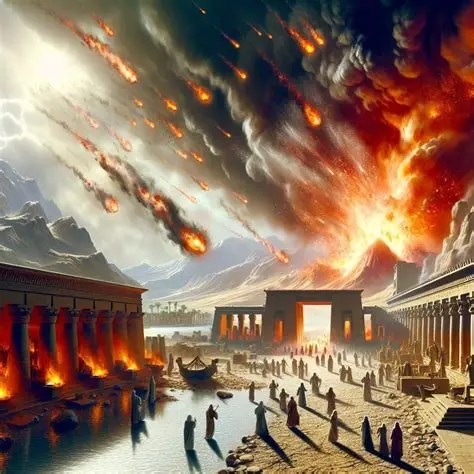
There are moments in Scripture when heaven doesn’t just speak — it *erupts*. And though all of the plagues created devastation, plague 7 is when the monumental terror truly begins. When Moses lifted his staff toward the sky, the air split with thunder, and hail came crashing down in violent sheets… but this was no ordinary storm. Fire streaked through the ice, blazing inside the falling hailstones as they rained down upon Egypt’s open fields; violently ripping branches from bushes and shredding leaves from plants, burning up nearly all crops the fire came into contact with. What little remained after earlier plagues was shattered in a single, terrifying sweep. Egypt was losing everything they had to be thankful for plague by devastating plague, each one worse than the one before it. There was truly no denying that this was judgment from above.
Exodus 9:13–35 lays out the sequence clearly: God commands Moses to stretch out his staff toward the sky, and a storm the likes of no other strikes Egypt. Before the storm hit, Moses had warned the Egyptians: anyone who feared the word of the LORD should bring their servants and livestock inside, so they would be spared from the coming destruction. And indeed, those who heeded this warning escaped the worst of this storm. Hail and fire, both separate and combined as one, fell from heaven, devastating everything left in the fields — men, animals, and plants all alike. The text emphasizes the supernatural character of this judgment: it is not merely a “natural disaster”, but a divinely orchestrated act of power, timing, and sovereign authority. The Hebrew word for “hail” (בָּרָד, barad) paired with “fire” (אֵשׁ, ʼesh) intensifies the imagery — ice that burns, a destructive force no man nor beast could survive on their own.
Egyptian Gods Targeted & How They Failed
The storm did more than destroy crops — it revealed the powerlessness of Egypt’s gods. Nut (pronounced noot), the sky goddess, stretched across the heavens as a protective vault. The Egyptians had looked to her for shelter, for the promise that the sky itself would watch over them always. Yet fire-streaked hail tore through her domain, a violent reminder that the heavens obey only Yahweh, the Lord of all creation. The sky she embodied could not shield those who clung to the belief of her.
Shu (pronounced shoo) and Tefnut (pronounced tef-noot), the divine balance of air and moisture, were next to be humbled. Shu upheld the sky; Tefnut carried the rains that nourished the land. Egyptians relied on them to sustain life, to maintain order, to bless their harvests. Instead, air and water became instruments of devastation. The elements meant to give life were twisted into agents of destruction, showing that these deities held no authority, because these deities were in fact powerless, impotent; they were faux, false, fake.
Seth (pronounced seth), god of storms and chaos, who the Egyptians feared and sometimes revered for his power over violent winds and tempests, was powerless as well. The storm did not obey him; its wrath belonged to Yahweh alone. Where Seth should have directed or contained the storm for the benefit of Egypt, it instead struck the land indiscriminately — a divine message that even chaos bows when the true Lord speaks, that even the wildest storms answer only to Yahweh.
And the gods of earth and harvest — Geb (G-ebb) and Osiris (Oh-sie-riss) — fared no better. Geb, the father of fertile soil, and Osiris, whose life-giving hand promised bountiful fields, were utterly exposed. Crops that remained after earlier plagues were smashed, leaves torn from bushes, stalks destroyed. The very gods tasked with sustaining Egypt’s food supply could not protect it, leaving the people to face the terrifying reality that their reliance on these deities was futile.
In this single plague, the Egyptians could see clearly that their gods were not gods at all. The sky, the air, the storm, the earth, the harvest — all fell under Yahweh’s sovereign authority. The fire and hail were not random; they were a confrontation with every god Egypt had trusted, and each failure left Egypt more exposed, more helpless, and more aware of the God who alone reigns over sky and soil alike.
When the Sky Turned Against Them
For the people of Egypt, this plague was not theology — it was survival. Fields that once promised bread were reduced to splintered stalks and blackened ash. Farmers who had already endured bloodied rivers, rotting frogs, biting insects, and diseased livestock now stood helpless as the last of their food was destroyed before their eyes. The barley and flax — crops that sustained daily life and trade — were obliterated in *moments*. Trees were stripped bare. Gardens flattened. What fire did not burn, hail shattered.
Those who ignored Moses’ warning paid a brutal price. Servants caught in the open were struck down. Livestock left in the fields were killed where they stood. The storm did not allow time to run, to gather, or to bargain. It fell suddenly and without mercy, turning routine labor into abject terror. The sky had become hostile, as if the sky itself was the Egyptians enemy, and wanted nothing more than death and destruction upon them all.
Inside homes, fear settled like smoke. Families listened as thunder roared and hail slammed against walls and roofs with relentless force. Parents held children close, unsure whether shelter would hold. Every crash carried the knowledge that tomorrow’s food, tomorrow’s safety, tomorrow’s survival might already be gone.
And when the storm finally passed, silence followed — the kind that only comes after true devastation. Fields lay ruined. Branches, some covering lifeless bodies, littered the ground. The air smelled of scorched plants and wet earth. Egypt had not simply lost crops; it had lost security, stability, and the illusion of control. Daily life could not simply resume — it had been fundamentally broken; the truth of their false gods laid bare for all to witness.
Yet the worst was still to come.
Could This Have Happened Naturally?
Some scholars and historians have attempted to explain this seventh plague as an extreme but natural weather event — a rare and violent storm system producing unusually large hail, paired with intense lightning. Egypt is not known for hailstorms of this magnitude, but they are not entirely impossible, especially during seasonal shifts when cold air masses collide with warm desert fronts.
However, Scripture itself does not invite us to reduce this event to coincidence.
First, the timing was precise. The storm did not arise randomly; it came only after Moses spoke the word of the LORD and stretched out his staff toward the sky. It began when God said it would begin and stopped when Moses prayed for it to end. Nature does not obey commands — unless commanded by its Creator.
Second, the selectivity matters. Scripture tells us that those who feared the word of the LORD and brought their servants and livestock indoors were spared. This was not indiscriminate destruction; it was conditional judgment. A purely natural storm does not pause to distinguish between belief and disbelief.
Third, the severity stands apart. Exodus emphasizes that there had never been a storm like it in Egypt’s history — neither before nor after. Fire running within the hailstones is described as something altogether unnatural, a merging of opposites that defied expectation and understanding.
Even if the elements themselves were familiar — hail, thunder, lightning — their convergence, timing, reach, and obedience reveal something far greater at work. What Egypt experienced was not simply weather gone wild; it was creation responding to its Maker; it was judgment executed at His command.
Pharaoh’s Confession — and His Collapse
As the storm raged and Egypt lay in ruins, Pharaoh summoned Moses and Aaron in desperation. His words sounded different this time — humbler, almost repentant. “I have sinned this time,” he confessed. “The LORD is righteous, and I and my people are wicked.” (Exodus 9:27)
It was an astonishing admission. Pharaoh, who had long positioned himself as divine, now openly acknowledged Yahweh’s righteousness and his own guilt. He didn’t merely ask Moses to pray to his God to stop the storm, he begged Moses to intercede, pleading for the thunder and hail and fire to stop. The devastation had finally reached a point he could no longer ignore or dismiss.
Moses agreed to pray — but not without warning. Pharaoh’s words, though correct, were not yet trustworthy. Moses made it clear that the storm would cease only so Pharaoh would know that “the earth is the LORD’s.” This was not a negotiation between equals; it was a demonstration of sovereignty.
And just as God had said, the moment Moses stretched out his hands in prayer, the storm stopped. Thunder fell silent. Hail ceased. Fire vanished from the sky.
Yet the calm revealed Pharaoh’s true heart.
When Pharaoh saw that the rain, hail, and thunder had stopped, he sinned again. His fear evaporated with the storm. His humility dissolved the moment the danger passed. Once more, Pharaoh hardened his heart — he and his officials alike — refusing to release the people of Israel.
The confession had been real. The repentance had not.
The Calm Before the Next Storm
For Egypt, the silence after the hailstorm was deceptive. Fields lay blackened, crops destroyed, and lives shattered. Smoke still lingered in the air, mingling with the scent of scorched plants and trampled earth. Families counted what little remained, realizing that even survival came at a cost too high to bear.
But the pause was temporary. God’s hand had not withdrawn; His judgment had simply shifted. The devastation of fire and ice had demonstrated His supremacy over sky, storm, and earth. Yet what remained vulnerable — the land, the food, the very sustenance of life — was not safe.
The next wave of judgment was already on the horizon. What hail had spared, the locusts would devour. What the storm had left in ruin, the swarms would consume entirely. Egypt had glimpsed the power of the true God, yet their hearts had not truly turned. And so, the stage was set for the next plague — a plague of hunger of literal Biblical proportions.
╔════════════════╗
☩ ONE CUP. ONE CHRIST. ONE CALLING. ☩
— SUNDAY MORNING COFFEE & CHRIST —
╚════════════════╝
For a full list of sources and references, visit the [Sources page]. To find the sources referenced for this post specifically, press Ctrl + F and search for “Plague 7: Ice & Fire From the Sky”.
Because truth isn’t afraid of being questioned.


Leave a comment