Ending of Plague Seven (Hail & Fire)
The hail ceased, the thunder fell silent, and the fire cooled, no longer running along the ground. Egypt stood stunned in the aftermath — fields shattered, trees splintered, and crops beaten into the earth. What had once symbolized abundance now testified against them.
Yet Pharaoh’s repentance proved as brittle as the stalks left standing. When the storm passed and relief returned, so did his hardened resolve. He sinned yet again, Scripture tells us — not in ignorance, but in full awareness of the hand that had struck him. The warning had been unmistakable. The cost had been severe. And still, his heart remained unmoved.
But judgment does not retreat when defiance resumes. The seventh plague left Egypt wounded. The eighth would leave it bare.
Beginning of Plague Eight
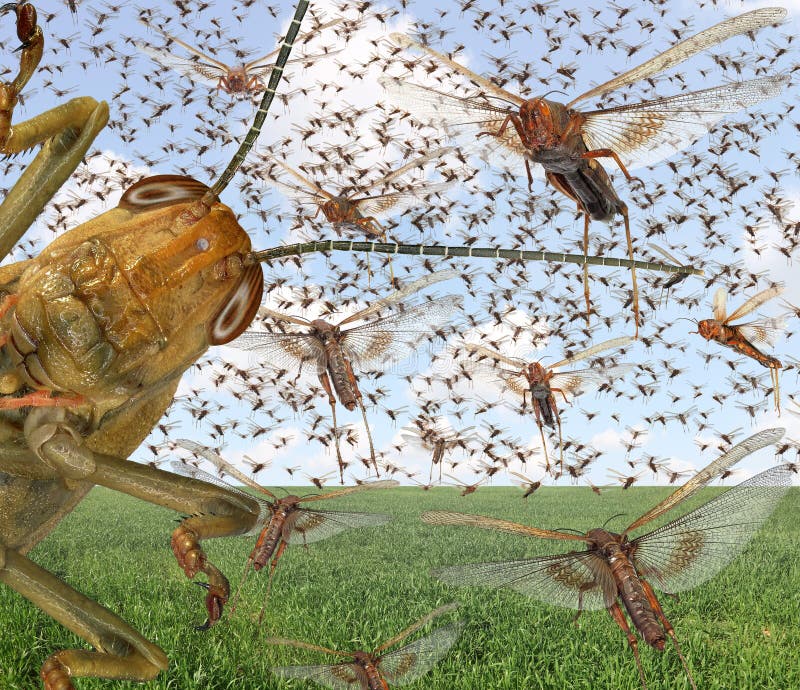
What the hail spared, the locusts were sent to consume. The Lord spoke again to Moses, not because Pharaoh had misunderstood — but because he had refused to submit. The devastation of Egypt was no longer a matter of proof, but of consequence. God declared plainly that He would bring locusts into Egypt, so numerous they would cover the surface of the land, devouring every remaining green thing left after the fire & hail.
This was not a natural disaster drifting in on chance winds. These locusts came at God’s command, summoned as instruments of judgment. Egypt’s fields, already bruised by fire and ice, would now be stripped clean — not a leaf, not a blade, not a remnant left behind.
And for the first time, Pharaoh’s own servants began to tremble.
“How long shall this man be a snare to us?” they pleaded. “Do you not yet understand that Egypt is ruined?”
But even with ruin at the doorstep and destruction in the air, Pharaoh hesitated — bargaining once more, delaying obedience, measuring submission on his own terms.
The land, however, would not wait.
The Theological Significance of Locusts
Throughout Scripture, locusts are not merely insects; they are harbingers of divine judgment, symbols of total consumption, and reminders that fruitfulness itself is a gift from God — not a guarantee of human effort. In the ancient Near East, a locust swarm represented one of the most feared and devastating calamities imaginable. Unlike hail or flood, locusts did not simply destroy once — they ate, moved, and consumed until nothing remained. Their arrival meant famine was inevitable, survival uncertain, and recovery slow. To send locusts was to strike not just the land, but the future.
This is precisely why God’s warning in Exodus 10 is so severe: “They shall cover the surface of the land, so that no one can see the land.”
Judgment here is not momentary — it is comprehensive.
Locusts as Covenant Curses
Long before Israel would ever step foot into the Promised Land, God had already defined locusts as a covenant consequence for rebellion. Deuteronomy 28 warns: “You shall carry much seed into the field but shall gather little in, for the locust shall consume it.” (v. 38).
This language is not incidental. Locusts appear when a people refuse to live under God’s rule, choosing autonomy over obedience. Choosing self over God. Egypt, though not bound by Israel’s covenant, is being judged by the same holy standard — because God’s sovereignty is not limited by covenant membership. Egypt trusted in its Nile, its gods of fertility, and its illusion of self-sufficiency. Locusts dismantled that lie. Every field stripped bare declared the same truth: man does not control provision — God does.
A Judgment That Builds Upon Judgment
The locusts did not arrive alone; they came after the fire and hail. This is critical. God did not start with total devastation. He escalated. What the fire and hail left behind, the locusts were sent to finish. Judgment in Scripture often moves in layers, not in one chaotic sweep — giving space for repentance before removal. Plague Eight announces that Egypt has crossed a threshold. No longer is God making His presence known by merely shaking the land; He is now removing its sustenance. There is a sobering pattern here: what we refuse to surrender, God eventually allows to be taken.
Take that warning to heart; or you, like the Egyptians, and much like myself, just might find yourself learning this lesson the hard way.
From Exodus to the Prophets
The theological echo of Plague Eight does not end in Egypt. Centuries later, the prophet Joel would describe a locust invasion using the language of divine armies and covenant reckoning: “What the cutting locust left, the swarming locust has eaten…” (Joel 1:4).
Joel’s locusts serve as both literal judgment and prophetic warning — pointing forward to a coming Day of the Lord. In both Exodus and Joel, locusts announce the same reality: when repentance is delayed long enough, judgment no longer whispers — it consumes in a screaming roar.
The Heart of the Warning
At its core, the plague of locusts reveals this truth: God does not merely judge sin; He judges the illusion that life can flourish apart from Him.
Egypt’s land was fruitful — until God said otherwise. And Pharaoh’s authority seemed absolute — until God made it known that it wasn’t. Locusts preach a hard sermon: what God gives, He can also withdraw. “The Lord giveth and the Lord taketh away.” Job 1:21.
And yet — even here — mercy lingers. Pharaoh is warned. His servants plead. The door to repentance is still cracked open, though narrowing fast. The question is no longer whether Egypt will obey. It is how much will be lost before it does.
The Gods Brought Low: When Egypt’s Providers Fell Silent
In Egypt, grain was not merely sustenance — it was sacred. Fields were believed to rise and fall with the favor of the gods, and harvest was proof that the divine order, ma’at, remained intact. As long as the land produced, Egypt believed itself protected. If they land was still providing, then surely they were living right.
But when the locusts came, they came to a land already bruised by judgment. They arrived to finish what the fire and hail had begun. The east wind carried them in — not as an accident of climate, but as a summons. The air itself obeyed the voice of Yahweh. What Egypt believed to be governed by divine intermediaries now answered to a higher throne.
Fields once entrusted to Neper (NEH-per) — the god of grain and harvest — were stripped bare. There was no god to intervene, no blessing to restore what vanished before their very eyes.
Osiris (oh-SIGH-riss), celebrated as the god of fertility, death, and resurrection, whom they believed died and rose anew each season with the crops, offered no resurrection this season. The land did not revive. It lay exposed and silent; dead and flat.
Even the wind betrayed Egypt. Shu (shoo), believed to govern the air and breath of life, did not breathe life back into their crops, nor did it restrain the swarm. The locusts came and went at Yahweh’s word alone — summoned and dismissed by a power Egypt could neither name nor control.
And Pharaoh himself — proclaimed son of the gods, living embodiment of divine order — stood powerless as the illusion of provision unraveled. His authority had always been measured by Egypt’s prosperity. Now, even his own servants could no longer maintain the lie.
The question rose again among Pharaoh’s servants — not in rebellion, but in recognition. How long would this man continue to ensnare them, while the land thundered in empty fury, and their gods lay silent and impotent; at the same time all around them, and yet somehow, nowehere to be found at all?
The gods they had trusted were not merely wounded. They were altogether absent. The locusts preached what no man could silence: the Nile did not give life, the gods did not sustain the land, and Pharaoh did not rule the wind. What Egypt worshiped had no power to protect what mattered most. In a single sweep, Yahweh did not just take Egypt’s crops — He took its confidence.
The land was bare because their gods were false.
Lessons Beyond the Locusts
Though you won’t find this in any public school history book, make no mistake, this is history. And its echoes are not trapped in the past. The lesson of Egypt, the locusts, and the silent gods thunders across time. Just as Pharaoh measured his authority by the land’s abundance, we too are tempted to trust in what we can see, hold, or control — our careers, our comforts, our possessions, even our relationships — as if they are unshakable. But Scripture reminds us: all provision comes from God, and He alone sustains life. What He gives can be taken away; and what He withholds can be purposeful.
In our modern world, the locusts may not swarm across fields, but their principle still bites: what we lean on apart from God can fail, falter, or vanish. The false gods of our hearts — pride, self-reliance, fleeting security — will never rescue us. Only God’s provision, His mercy, and His sovereign hand endure.
The question given to us now is the same one that Pharaoh could not answer then: will we surrender before what we treasure most is stripped away, or will we wait until the locusts have already consumed what we thought could never be taken?
Take heed: when the false gods fall silent, only one voice remains — the voice that gives, the voice that takes, and the voice that redeems – the voice of Yahweh.
When History Groans Alongside Scripture
Ancient Egyptian royal inscriptions were never intended to function as neutral histories. They were propaganda texts — carved to glorify Pharaoh, display divine favor, reinforce cosmic order (ma’at), and legitimize rule. Stone walls remembered victories, not vulnerability; abundance, not absence. They did not memorialize humiliation. And they certainly did not celebrate moments when Egypt’s gods failed and its king stood powerless.
When defeat did enter Egypt’s memory, it was rarely named as such. Loss was reframed as victory, chaos blamed on foreigners or disorder, and shame buried beneath myth and symbolism. True lament did not belong on temple walls or triumphal stelae; it surfaced instead in obscure texts — whispered rather than proclaimed, preserved on fragile papyrus rather than eternal stone.
For this reason, the absence of an Egyptian inscription proudly recounting a nation undone by locusts, famine, and a humbled Pharaoh should not surprise us. Silence, in this case, is not evidence against Scripture — it is consistent with how Egypt chose to remember itself.
And yet, within Egypt’s own literature, something important still breaks through.
One of the most discussed texts in relation to the plagues is the Ipuwer (pronounced ee-POO-werr) Papyrus, also known as Papyrus Leiden I 344. It is not a historical record in the modern sense, but a lament — a poetic outcry describing a land in collapse. It speaks of famine, social upheaval, ruined fields, and the unraveling of order once thought secure. Egyptologists debate its precise date and purpose, but its existence reveals something crucial: the Egyptians themselves were familiar with national catastrophes that looked strikingly similar to the conditions Scripture describes during the plagues.
Egypt knew what it was to watch stability unravel. Beyond this, we possess texts that speak even more directly to the terror of locust devastation. An ancient document known as Papyrus Anastasi VI records an official report describing crops destroyed by locusts — with chilling simplicity: “the grain has perished by locust.”
No theology. No interpretation. Just loss. The kind of loss that feeds famine and fear.
Egyptian artwork reinforces this reality. Tomb and wall reliefs depict workers battling swarms of winged insects in the fields — visual acknowledgments that locusts were not mythical horrors, but known enemies of survival. Egypt’s bureaucracy prepared for them. Its people feared them. Its land suffered under them.
In other words, the plague of locusts described in Exodus does not emerge from ecological fantasy. It fits squarely within what we know of the ancient world — a world utterly vulnerable to the stripping power of a swarm.
Still, this must be said plainly: the absence of a specific Egyptian record describing this plague specifically is not evidence that it did not occur. Archaeology is fragmentary. Papyrus, fragile as it is, decays. Records are lost. And humiliations are often intentionally erased. History, especially ancient history, survives in pieces — and silence is often as telling as speech.
What Scripture gives us, then, is not a borrowed myth nor an exaggerated fear, but a theological interpretation of real forces placed under divine command. Egypt knew locusts. Egypt knew famine. Egypt knew collapse. What Egypt did not know — until Yahweh made it unmistakably clear — was that these forces answered to Him, and Him alone. The plagues are not merely natural disasters remembered with religious flair. They are natural realities summoned, restrained, and dismissed by the sovereign hand of God.
And that is the point of truth that history cannot erase.
When the Land Is Bare
The locusts lifted as they had come — at Yahweh’s command. Plague Eight did not end with death — it ended with emptiness. It ended with lack.
Lack of crops. Lack of promises. Lack of the illusion of power and self-control that Egypt once had.
But Egypt still breathed. And Pharaoh still ruled. What had changed was that the land that once proclaimed divine favor now testified against him.
Yet still, even then, Pharaoh would not yield.
And so the judgment would no longer target what Egypt owned and used in order to live off of — their water, their land, their animals, crops, and fields. It would next target what Egypt saw.
For when a people refuse the light long enough, God sometimes answers with darkness.
And when the land was stripped bare and their false gods proved to be just as dead as their cattle and as empty as their fields, that darkness was already gathering.
╔════════════════╗
☩ ONE CUP. ONE CHRIST. ONE CALLING. ☩
— SUNDAY MORNING COFFEE & CHRIST —
╚════════════════╝


Leave a comment